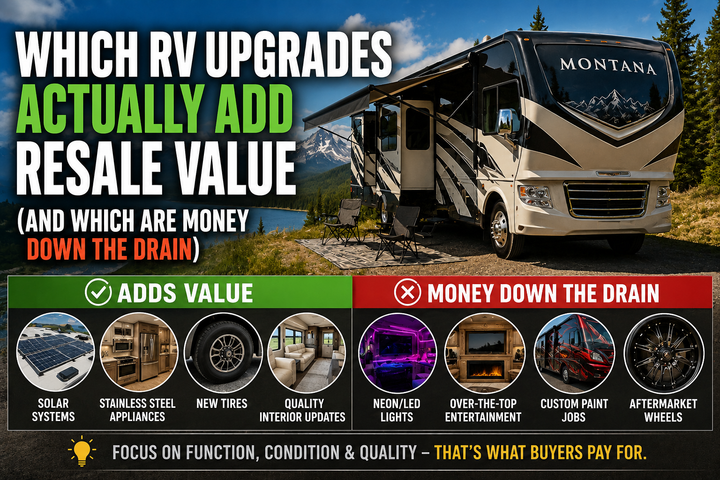
Which RV Upgrades Actually Add Resale Value (and Which Are Money Down the Drain)
You'll rarely recover more than 25–50% of any RV upgrade — but the right ones sell your rig weeks faster. What buyers actually pay for (lithium, solar, fresh tires, documented roof work), what they don't, and how to present upgrades in your listing.

Every RV forum has the same recurring thread: someone spent $14,000 upgrading their rig, listed it for book value plus $14,000, and can't understand why the phone isn't ringing. The hard truth is that you almost never recover 100% of what you spent — on the best upgrades, sellers typically recoup between a quarter and half of recent retail cost in a private sale, and only when the work is clean and documented.
That doesn't make upgrades pointless. It means you're buying two different things: partial cost recovery, and — often more valuable — a faster sale. The right upgrades make your listing the one that gets clicked, inspected, and bought while the identical rig two towns over sits for months. The wrong ones shrink your buyer pool or, worse, read as red flags that scare buyers off entirely.
Here's what the market actually rewards, what it punishes, and how to present the difference in your listing.
The Core Rule: Partial Recovery Plus a Faster Sale
RVs depreciate on a curve that no upgrade can beat — a five-year-old fifth wheel is worth what five-year-old fifth wheels are worth, give or take. (See our real-world breakdown of RV depreciation by class and year.) Upgrades work at the margins of that number, in three ways:
- Direct recovery: roughly 25–50% of the recent retail cost of genuinely sought-after upgrades, in a private sale, with documentation. Dealer trade-ins recover far less — often nothing.
- Time-to-sell: the bigger payoff. An RV that sells in three weeks instead of four months saves you storage, insurance, another season of depreciation, and the slow-motion price cuts that stale listings invite.
- Negotiating strength: a well-upgraded, well-documented rig gives buyers fewer reasons to chip at your price.
One more principle before the lists: an upgrade only adds value if the buyer would have paid for it anyway. Off-grid power, safety, and reliability items pass that test for a broad slice of buyers. Taste-based items pass it only for buyers who share your taste — and every layer of personalization shrinks the pool.
Upgrades That Genuinely Help You Sell
Lithium battery and inverter systems
The most-asked-about upgrade category in used listings right now. A lithium (LiFePO4) bank with a proper inverter/charger answers the modern buyer's first question — "can I boondock and work from this thing?" — before they ask it. Lithium batteries run roughly $300–$900 per 100Ah in 2026, and a complete 400–600Ah system with a 3,000W inverter typically lands at $3,000–$8,000 installed. Buyers pay real premiums, but only when the install looks factory-grade: correct wire gauge, proper fusing, a battery monitor, and a wiring diagram in the paperwork. A sloppy install of expensive parts is worth less than no install at all.
Solar — installed cleanly, with documentation
Solar amplifies the lithium story. Professionally installed rooftop systems run from about $1,000–$1,800 for a modest 300–400W setup to $4,500–$8,000+ for full off-grid systems above 1,000W. The value at resale hinges on two things: clean roof penetrations (a buyer's inspector will go straight to them, because every hole in an RV roof is a future leak) and paperwork — panel and controller model numbers, install receipts, and a system diagram. "800W solar, 460Ah lithium, 3,000W inverter, installed 2025 by [shop], full documentation" is one of the strongest single lines a used-RV listing can carry.
Suspension and hitch upgrades on towables
Wet-bolt kits, upgraded equalizers, disc-brake conversions, and heavier shock packages tell an experienced buyer this trailer was maintained by someone who understood it. These are upgrades buyers can't see on a walkthrough — exactly why documenting them matters. A quality weight-distribution or fifth-wheel hitch included in the sale sweetens the deal for first-time buyers who'd otherwise face an immediate $800–$2,500 purchase.
New tires with recent date codes
Savvy RV buyers check tire date codes before they check the fridge. RV tires age out before they wear out — five to seven years is the usual replacement window regardless of tread — and a set of quality ST tires runs roughly $600–$1,200 installed on a tandem-axle trailer, far more on a motorhome. Fresh date codes remove a known four-figure objection and signal that you didn't defer maintenance. This is one of the highest-percentage-recovery upgrades there is, because the buyer was going to have to buy them anyway.
Roof reseal with documentation
Water is what every used-RV buyer fears most. A professional roof inspection and reseal (or quality coating) in the last twelve months, with dated receipts and photos, defuses that fear better than anything you can say. This rarely adds a premium — instead it protects the price you're asking and dramatically shortens negotiations.
Backup and observation cameras
Inexpensive relative to their effect. A wired or wireless observation camera system ($150–$600, more with professional install) removes a genuine anxiety for buyers moving up to a bigger rig. Many late-model towables already have camera-prep wiring, making this an easy, tidy install.
Connectivity prep: cellular boosters and Starlink
Remote work made internet the fourth utility. A cell booster, roof-mounted antenna, or clean Starlink provisioning — routed cabling, a dedicated 12V drop, a flat-mount bracket — costs a few hundred dollars and speaks directly to working-traveler buyers. You don't need to include the dish itself; the clean wiring and mount are what buyers can't easily replicate.
Washer-dryer in full-time rigs
In a fifth wheel or Class A that's plumbed for it, a washer-dryer combo or stacked set ($1,200–$2,500 typical) is a strong selling point to the full-timer market — the buyers who want a large, residential-style rig in the first place. In a weekend trailer, the same appliance just eats a closet.
Upgrades That Are Money Down the Drain
Paint wraps and graphics
A $3,000–$8,000 wrap or graphics package returns close to nothing. Your taste in stripes is not the buyer's taste in stripes, wraps age visibly in UV, and buyers wonder what the wrap is hiding. Full repaints on older motorhomes can help a sale, but rarely recover their substantial cost.
High-end, highly personal interior remodels
This is the great renovated-RV debate, and the evidence lands in an uncomfortable middle. Well-executed, neutral renovations — fresh flooring, light paint, updated hardware — can genuinely help older rigs sell, and a real market exists for "done" renovated campers. But the more dramatic and personal the remodel, the smaller the buyer pool. As one industry veteran put it, manufacturers design interiors to appeal to perhaps 90% of buyers; your custom renovation might appeal to 10%. Bold accent walls, farmhouse shiplap, removed dinettes and bunks, and $5,000 tile showers all subtract flexibility the next owner would have preferred as a lower price. Two structural cautions: weight (tile, real wood, and granite eat cargo capacity) and trade-in reality — many dealers won't take heavily modified units at all.
Cheap DIY electrical
Worse than zero return — it's negative. Undersized wire, missing fuses, zip-tied inverters, and mystery switches are the fastest way to fail a pre-purchase inspection and spook a buyer off the whole rig. If your electrical work doesn't look like a professional did it, either have it redone and documented or expect it to cost you money at sale time.
Permanently installed niche gear
The ham-radio tower, the bolted-down 400-pound gun safe, the custom kayak crane: gear that serves your specific hobby narrows your market to buyers with the same hobby. If it unbolts, unbolt it before listing, patch and seal the holes properly, and sell it separately — you'll get more for both.
Common Upgrades: Cost vs. Recovery vs. Time-to-Sell
| Upgrade | Typical Cost | Typical Value Recovery | Effect on Time-to-Sell |
|---|---|---|---|
| Lithium battery + inverter system | $3,000–$8,000 | 25–50% (documented) | Strong — top search filter for boondockers |
| Rooftop solar (installed) | $1,000–$8,000 | 25–50% (clean install) | Strong, especially paired with lithium |
| New tires (recent date codes) | $600–$1,200+ (towable) | 50%+ — removes a required buyer expense | Strong — kills a common objection |
| Roof reseal / coating + records | $300–$3,000 | Protects asking price rather than raising it | Very strong — defuses the #1 fear |
| Suspension / brake upgrades (towable) | $300–$4,000+ | 15–40% | Moderate — wins over experienced buyers |
| Backup / observation cameras | $150–$600 | 25–50% | Moderate — helps first-time big-rig buyers |
| Cell booster / Starlink prep | $200–$800 | 25–50% | Moderate–strong with remote workers |
| Washer-dryer (full-time rigs) | $1,200–$2,500 | 25–40% in the right rig | Strong with full-timers; neutral otherwise |
| Paint wrap / custom graphics | $3,000–$8,000 | Near zero | Neutral to negative |
| Bold personalized remodel | $5,000–$20,000 | 0–25%, often negative vs. clean original | Slower — shrinks the buyer pool |
| DIY electrical (undocumented) | Varies | Negative — inspection red flag | Negative |
Treat the percentages as directional, not gospel — condition, market season, and rig type move them. But the ordering holds up remarkably well across classes.
The Documentation Multiplier
Here's the part almost everyone skips, and it's worth real money: an undocumented upgrade is a claim; a documented upgrade is an asset. The same $6,000 power system might recover $1,500 as a bullet point ("has solar!") and $3,000 as a documented system with receipts, model numbers, install photos, and a wiring diagram. Documentation converts buyer skepticism — the default state of every used-RV shopper — into confidence.
Build a buyer's binder: receipts for every component, photos taken during installation (especially roof penetrations and wiring runs before walls closed up), a dated maintenance log, manuals, and warranty cards for anything still covered. Keep a physical copy in the rig and a PDF for serious inquirers. Sellers with this binder routinely watch inspections turn from negotiations into formalities.
How to Present Upgrades in Your Listing
Three rules separate listings that convert from listings that sit:
- Itemize, don't summarize. "Many upgrades!" is noise. "460Ah Battle Born lithium, Victron 3,000W inverter/charger, 800W rooftop solar (installed 3/2025), new Goodyear Endurance tires 11/2025, roof resealed 4/2026" is signal. Specific model names let buyers verify value themselves — which is the point.
- Sell the benefit, not the price you paid. Never write "spent $9,000 on upgrades, asking half." Buyers don't owe you your money back, and that framing invites argument. Write what the upgrade does: "run the air conditioner off-grid," "work from anywhere," "no tire worries for five years."
- Price the rig, then let upgrades justify it. Start from what comparable unmodified units actually sell for, then position yours at the strong end of that range with the upgrades as the reason — not stacked on top. Our guide to pricing your RV in 2026 walks through finding that baseline.
And remember that the brand on the sidewall still matters more than anything you bolted to it — upgrades move the needle furthest on RV brands that already hold their value, because those buyers are pickier and pay for quality signals.
Frequently Asked Questions
Do RV upgrades increase resale value?
Partially. Sought-after upgrades — lithium power, solar, new tires, documented roof work — typically return 25–50% of their recent retail cost in a private sale when cleanly installed and documented. The larger payoff is usually a faster sale and stronger negotiating position. Personalized cosmetic upgrades return far less and can actually shrink your buyer pool.
What is the best upgrade for RV resale value?
A documented lithium battery and solar power system delivers the strongest combination of recovery and buyer demand, because off-grid capability is the top request from today's used-RV shoppers. New tires with recent date codes are the highest-percentage play, though — buyers know they'd otherwise face that four-figure expense immediately, so fresh rubber converts almost directly into price protection.
Do renovated RVs sell for more?
Sometimes — it depends on execution and restraint. Clean, neutral renovations (fresh flooring, light paint, updated hardware) help older rigs sell faster, and a real market exists for professionally renovated campers. But bold, personalized remodels shrink the buyer pool, and many dealers refuse heavily modified units for trade-in. Quality of workmanship matters more than the style you chose.
Does adding solar increase an RV's value?
Yes, when it's installed cleanly and documented. Expect to recover roughly 25–50% of a professionally installed system's cost, plus meaningfully faster buyer interest. Value depends on tidy roof penetrations, correct wiring, and paperwork — receipts, model numbers, and a system diagram. A sloppy install with visible shortcuts can subtract value, because inspectors treat every roof hole as a potential leak.
Should I mention what I paid for upgrades in my listing?
No. Itemize each upgrade with model names and install dates, but sell the benefit — off-grid power, worry-free tires, a dry documented roof — rather than the invoice. Stating what you paid invites buyers to argue about depreciation and signals you're pricing emotionally. Let documented specifics justify a price set from comparable sales.
Do new tires help sell an RV?
Significantly. Experienced buyers check tire date codes early because RV tires age out in roughly five to seven years regardless of tread, and replacement runs $600–$1,200+ on a towable and far more on a motorhome. Current-year date codes remove that objection, signal diligent maintenance, and are among the highest-recovery upgrades you can make before listing.
If you've put real money and care into your rig, the best return comes from selling it yourself — private sale is where documented upgrades actually get paid for, and where a dealer's trade-in sheet would zero them out. List your RV on TrueRVs, itemize every upgrade with photos and receipts, and keep 100% of the sale price when the right buyer finds it.