How to Write an RV Listing That Actually Sells: Photos, Pricing, and Copy That Converts
Most RV listings fail on three things: starved photos, missing specs, and emotional pricing. Here’s the full playbook—the roof-to-tires shot list, golden-hour staging, the two sentences that stop the scroll, and data-driven rules for when to drop your price.

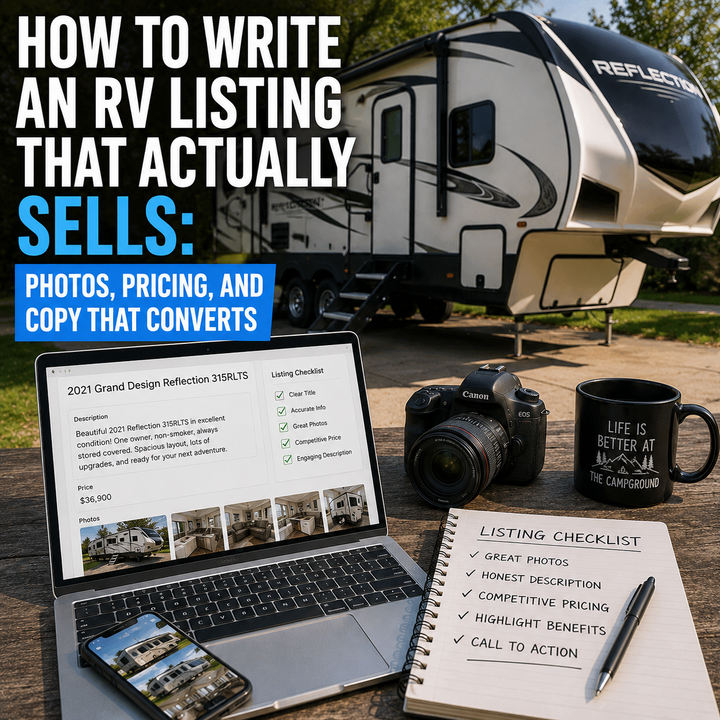
Scroll any RV marketplace and you'll see the same listing over and over: seven blurry photos taken at noon in a storage lot, a title like "2018 Keystone Cougar," and a description that reads "Great condition, lots of upgrades, call for details." That listing will sit for months while the seller wonders why nobody's calling. Meanwhile, an identical rig two towns over — same year, same floorplan, priced $1,500 higher — sells in nine days because the seller treated the listing like the sales document it is.
Your listing is doing one job: converting a thumbnail-and-headline glance into a serious inquiry. Buyers scrolling a results page give each listing a second or two. The photo, the price, and the first line of text either stop the thumb or they don't. Everything in this guide serves that moment.
Here's the complete playbook — the shot list, the specs buyers actually filter by, the copy formula, and the pricing discipline that separates a two-week sale from a six-month slog.
Why Most RV Listings Fail
Three failure modes account for nearly every stale listing:
- Starved photos. A handful of dim, cluttered shots — and almost never the ones buyers are anxious about (roof, tires, water damage areas). Buyers assume anything you didn't photograph is something you're hiding.
- Missing filter data. No length, no dry weight, no sleeping capacity, no slide count. If the specs buyers filter and search by aren't in your listing, you're invisible to the exact people shopping for your floorplan.
- Emotional pricing. "We paid $78,000 and only used it eleven times" is a story, not a price. The market doesn't reimburse memories, and a rig priced on what you owe or what you paid will sit until the price meets reality.
Fix those three and you're already ahead of most of the listings you're competing with.
The Photo Shot List (25–35 Photos, In This Order)
Photos carry your listing. Aim for 25 to 35, shot in this sequence, and lead with your absolute best exterior three-quarter angle — it becomes your thumbnail and does more work than every word you'll write.
| Category | Shots | Why It Converts |
|---|---|---|
| Exterior | All four corners, plus straight-on front and rear | Proves there's no hidden body damage or delamination on the "off" side |
| Roof | 2–3 shots from up top: membrane, seams, around every vent and AC unit | Roof condition is the #1 buyer fear on used RVs; showing it builds instant trust |
| Underbelly | Underneath shots: frame, tanks, corroplast condition | Screens out rust and damage questions before they're asked |
| Slides | Every slide fully extended, inside and out, plus slide seals | Demonstrates the mechanisms work — a major repair-cost worry |
| Living areas | Kitchen, bath, every sleeping area, dinette, ceiling corners | Ceiling and corner shots quietly answer the water-damage question |
| Systems | Battery bay, tank valves, water heater, converter/panel, generator with hour meter | Serious buyers are buying the systems, not the upholstery |
| Tires | Tread close-ups plus the DOT date code on the sidewall | RV tires age out before they wear out; showing date codes signals an honest seller |
| Proof | Odometer and/or generator hour meter, maintenance records fanned out | Documentation photos convert lookers into callers |
Golden Hour and Staging
Shoot exteriors in the hour after sunrise or before sunset — low, warm light flatters gelcoat and hides minor oxidation that harsh noon sun exaggerates. Park somewhere clean with a simple background: a park, an open field, an empty lot. Not your driveway with trash cans in frame, and not wedged between rigs in a storage yard.
Inside: remove every personal item — family photos, toiletries, the dog bed, everything on the counters. Open all the blinds, turn on every light, and shoot interiors from chest height at the corners of each room to maximize the sense of space. Deploy the awning, extend the slides, and set the dinette like someone could sit down to coffee. A $150–$300 professional detail before the shoot returns its cost several times over; buyers read "clean" as "maintained."
The Specs Buyers Filter By (Put Them All In)
Marketplace search filters decide who ever sees your listing. Include every one of these, exactly and accurately:
- Year, make, model, and floorplan code (e.g., "29RLS") — buyers search floorplans by name
- Length (actual, not model-number length) and height
- Dry weight and GVWR — half-ton-towable is a massive search category
- Sleeping capacity, and what the beds actually are (queen, bunks, convertible dinette)
- Number of slides
- Mileage (motorhomes) and generator hours
- Fresh/gray/black tank capacities
- Hitch type for towables, chassis and engine for motorhomes
Then the honesty section: recent maintenance with dates (bearings packed, roof resealed, tires replaced), and known flaws. Which brings us to the counterintuitive part.
Disclose the Flaws — It Sells Faster
A listing that says "small delamination bubble on the lower rear corner, photo #22, priced accordingly" outperforms one that hides it. Here's why: every experienced RV buyer walks in expecting to find problems. When you name the flaws yourself, you flip the dynamic — the buyer stops hunting for what you're hiding and starts evaluating a rig they already trust. Disclosed flaws also pre-neutralize the negotiation: you've already priced it in, so the "I found delamination, knock off $3,000" move is dead on arrival. Hidden flaws, by contrast, kill deals at the walkthrough — after you've burned weeks on that buyer.
Write the First Two Sentences for the Scroll
Most platforms show only the first line or two of your description in search results and previews. Don't spend them on throat-clearing. Lead with the three or four facts that make your rig the right answer to a specific buyer's search:
Weak: "Selling our beloved camper. We've made so many memories in it and it's been very well taken care of."
Strong: "One-owner 2021 Grand Design Imagine 2500RL, 6,600 lbs dry and half-ton towable, always stored covered, with new Goodyear Endurance tires (2025) and full service records. No pets, no smoking, no water damage — every seam photographed."
Same rig. The second one names the floorplan, answers the tow-vehicle question, and stacks three trust signals before the buyer has scrolled an inch. After the opener, structure the rest in short scannable blocks: what's new/recent, systems and condition, flaws, what's included (hitch, hoses, chocks), and how to see it.
Price Against Sold Comps, Not Asking Prices
The asking prices you see on marketplaces are what hasn't sold yet. Pricing against them means anchoring to other sellers' wishful thinking. Instead, triangulate: pull the J.D. Power (NADA) value for your exact model and options, note what comparable rigs are listed for and how long they've been listed, and weight everything toward units that actually moved. A rig relisted for 90 days at $52,000 isn't a comp — it's a warning. We walk through the full valuation process in our practical guide to pricing your RV in 2026 and the deeper complete 2026 RV valuation guide.
Two pricing tactics that work:
- Price just under the round-number filter breaks. $39,900 appears in "under $40,000" searches; $40,500 doesn't. Those filter walls matter more than the $600.
- Leave a realistic negotiation margin — 3–5%, not 15%. Padding "room to negotiate" into the price just filters you out of searches and attracts nobody. Almost every RV buyer expects to negotiate something; build in a little, not a lot.
When to Drop the Price
Let the data decide, not your mood. Track views and inquiries weekly and read the pattern:
- Low views: a search visibility problem — check your specs, thumbnail, and whether you're just above a price filter break.
- Views but no inquiries: a price or photo problem — buyers are seeing it and scrolling past.
- Inquiries and showings but no offers: a condition or expectation gap — the listing is overselling the rig.
A useful rule: if you've had healthy traffic but no serious offer in 3–4 weeks, cut 3–5% in one clean move rather than a $250 drip every few days. Meaningful drops re-trigger price-drop alerts and re-enter you into lower price-filter brackets; token drops just teach watchers to wait you out. And remember RV shopping is seasonal — a listing stalling in November tells you less than one stalling in May.
Respond Fast or Lose the Buyer
Private-party RV buyers inquire on several rigs at once, and the seller who answers first usually gets the showing. Treat the first hour after an inquiry as sales time: reply immediately, answer the question actually asked, and offer two specific showing windows ("Saturday 10am or Sunday 2pm work?"). Have a standing folder — photos of the title, service records, and answers to the usual questions (tire dates, roof reseal, tank sizes) — so you can respond in minutes, not evenings. Slow replies don't just lose that buyer; they push your listing into the stale pile while faster sellers close.
Pre-Listing Prep: What Pays and What Doesn't
| Worth Doing | Skip It |
|---|---|
| Full professional detail, roof wash, awning cleaning | Full renovation or new furniture — buyers repaint anyway |
| Fix the $5–$50 stuff: burned-out bulbs, loose latches, torn screens, dead smoke detector batteries | Major appliance upgrades you won't recoup |
| Reseal roof seams if due; keep the receipt for the listing | Replacing dated-but-functional flooring or countertops |
| Fresh tires if date codes are 6+ years old (or price the replacement in and say so) | Aftermarket add-ons buyers didn't ask for |
| Organize maintenance records into one binder | Paying to "certify" the rig through a buyer-supplied service |
The pattern: money spent making the rig look cared for returns multiples; money spent making it different returns pennies. Small unfixed annoyances hurt disproportionately, because a buyer who finds three broken latches starts wondering what else was neglected.
All this effort is exactly why selling private beats trading in — the listing work above is what captures the thousands of dollars a dealer would otherwise pocket. We run the numbers in trade-in vs. private sale.
Frequently Asked Questions
How many photos should an RV listing have?
Aim for 25 to 35 photos. Cover all four exterior corners, the roof, the underbelly, every slide extended, each living area, the systems (battery bay, tanks, generator hour meter), tire date codes, and the odometer. Buyers assume anything you didn't photograph is a problem you're hiding, so more honest coverage directly increases inquiries and shortens negotiation.
What's the best time of day to photograph an RV?
The hour after sunrise or the hour before sunset — golden hour. Low, warm light flatters fiberglass and paint, hides minor oxidation, and avoids the harsh shadows and blown-out highlights of midday sun. Park somewhere clean and uncluttered, extend the slides and awning, and shoot your best front three-quarter angle first, because that shot becomes your search thumbnail.
Should I mention problems with my RV in the listing?
Yes. Disclosing flaws with photos and pricing them in builds trust, filters out mismatched buyers early, and kills the walkthrough renegotiation where a buyer "discovers" the issue and demands thousands off. Hidden problems don't stay hidden — they surface at the showing after you've invested weeks in that buyer. Honest listings consistently sell faster and closer to asking.
How should I price my used RV?
Start with the J.D. Power (NADA) value for your exact model and options, then adjust against comparable listings — weighting rigs that actually sold, not ones sitting unsold for months. Price just under round-number search breaks (like $39,900 instead of $40,500) and leave only 3–5% negotiation margin. Condition, tires, roof history, and records justify the top of the range.
When should I lower my RV's asking price?
Watch the data weekly. Low views means a visibility problem — fix specs and thumbnail first. Good views with no inquiries means price or photos. If you've had steady traffic but no serious offer in three to four weeks during selling season, make one clean 3–5% cut rather than small drips; a meaningful drop re-triggers alerts and enters new price-filter brackets.
What should the first line of my RV listing say?
Lead with the facts a searching buyer filters for: year, make, model, floorplan code, dry weight or towability, and your strongest trust signals — one owner, stored covered, new tires, full records, no smoking or water damage. Most platforms preview only the first sentence or two, so skip the sentimental intro and answer the buyer's question before they scroll past.
When your photos, specs, and price are ready, put them where private sellers keep the whole sale price. TrueRVs listings are free, you deal directly with buyers, and there's no commission taken off the top — every dollar of the deal you just optimized stays yours. List your RV on TrueRVs and put this playbook to work.