How to Sell an RV You Still Owe Money On: Lien Payoff, Title, and Escrow Step by Step
You can sell an RV with a loan on it — you just need the right process. How to get a 10-day payoff quote, the three safe ways to close (direct payoff, lender branch, licensed escrow), realistic lien-release timelines, and what to do if you're underwater on a 2021–2022 purchase.

Most "how to sell your RV" advice pretends the title is sitting in your filing cabinet, free and clear. But a huge share of RVs sold privately still have a loan on them, and if a bank holds a lien on your rig, you can't just sign the title over in a parking lot. You absolutely can sell it, though — you just need a process that pays the lender first, protects the buyer's money, and gets a clean title into their hands.
The mechanics are more paperwork than pain: request a payoff quote, figure out whether you're above or below water, pick one of three closing methods, and manage the window between payoff and title delivery. This guide walks through every step — including what to do when you owe more than the RV is worth, which describes a lot of people who financed at peak prices in 2021 and 2022.
Step 1: Get a 10-Day Payoff Quote from Your Lender
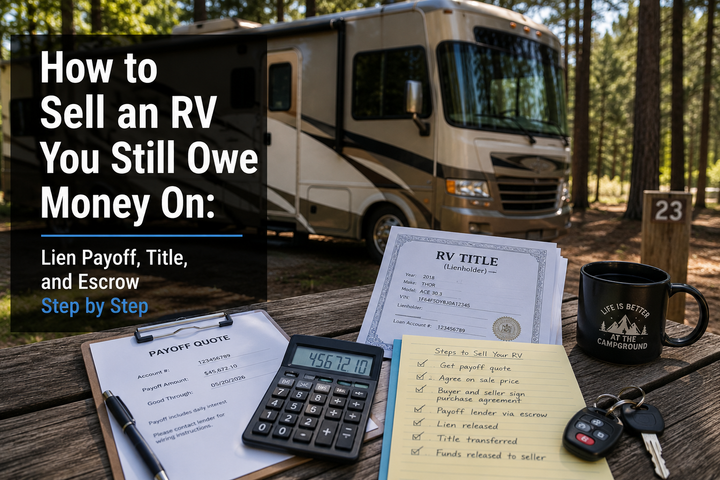
Your monthly statement balance is not your payoff amount. Interest accrues daily, so the true number to clear the lien changes every day. That's why lenders issue a 10-day payoff quote: the exact amount — principal, accrued interest, and fees — required to close the loan if payment arrives within 10 days, with a per-diem interest cushion built in so the figure holds through the window.
Getting one takes five minutes: call your lender or use your loan portal, and request it in writing. Confirm:
- The exact payoff amount and expiration date. If your sale closes after the quote expires, request a fresh one — the number will tick up slightly.
- Where and how to send funds. Wire instructions, overnight mailing address for a cashier's check, or whether a buyer's lender can pay them directly.
- How the lien release works after payoff. Ask whether they use electronic lien and title (ELT) in your state, and how long release typically takes — you'll quote this to your buyer later.
Do this before you list, not after you have an offer. The payoff number is the foundation of your pricing math.
Positive or Negative Equity: Know Which Sale You're Running
Subtract the payoff from your RV's realistic market value. Positive result: you have equity, and the buyer's money pays the lender with the remainder coming to you. Negative: you're "underwater," and you'll need to bring cash (or borrow it) to close the gap at sale time.
If you bought in 2021 or 2022, brace yourself. RV loans commonly run 15 to 20 years, and on those terms the early payments are overwhelmingly interest — after four or five years, many borrowers have barely dented the principal. Meanwhile, RVs lose a large share of their value in the first five years, and pandemic-peak units depreciated from an inflated starting point. Slow paydown plus fast value normalization left many 2021–2022 buyers owing more than their rig is worth in 2026. It's not a moral failing; it's amortization math.
Get your value number honestly — check sold listings for your exact model and use our complete 2026 RV valuation guide to price against the market, not your loan balance. If you're weighing whether current rates make selling or refinancing smarter, see our 2026 RV financing guide.
The Three Ways to Close a Lien Sale
Every safe version of this transaction does the same thing: the buyer's money goes to the loan before ownership changes hands. Three standard ways to arrange it:
Path 1: Buyer pays your lender directly, you cover any gap
The buyer sends payment — cashier's check, wire, or their own lender's check — straight to your lienholder, referencing your loan account. If the price exceeds the payoff, the buyer splits payment: payoff to the lender, remainder to you. If you're underwater, you send your gap payment at the same time so the loan zeroes out. This path is free but demands the most trust and coordination. Put every detail in a written bill of sale.
Path 2: Close at the lender's local branch
If your lender is a bank or credit union with a branch nearby, this is the cleanest free option. You and the buyer sit down together; the branch verifies the payoff on the spot, accepts the buyer's funds, disburses your equity (or collects your gap payment), and initiates the lien release while you both watch. Buyers relax visibly when a banker runs the closing. Call ahead — not every branch handles payoffs at the counter.
Path 3: A licensed escrow or title service
For long-distance deals, big-dollar coaches, or any nervous buyer, a neutral third party earns its fee. Licensed escrow services (including RV title-and-escrow specialists) hold the buyer's funds, pay off your lender, verify the lien release, handle title transfer, and only then release the balance to you. Fees typically run from a few hundred dollars to roughly 1–3% of the price, often split between the parties. Use only a licensed escrow company you find independently — fake escrow sites are a known scam.
The Waiting Game: Lien Release and Title Timing
Here's what kills more of these deals than anything else: even after the loan is paid in full, the title doesn't appear instantly. Lenders typically verify the funds cleared and issue the lien release within about 10 business days; from there, getting a clean title into the buyer's hands typically takes two to six weeks, depending on your state and whether your lender uses electronic lien and title (ELT states often process in days; paper states run slower).
One wrinkle: in title-holding states — Kentucky, Maryland, Michigan, Minnesota, Missouri, Montana, New York, and Wyoming — you already hold the physical title with the lien printed on it. There, the lender issues a lien release document after payoff, and the title plus release together let the buyer register — often faster, since nobody waits on mail.
Keep the buyer comfortable during the wait by making the timeline explicit up front:
- Show them the written payoff quote before closing so they see exactly where their money goes.
- Write the title-delivery window into the bill of sale, with your obligation to forward the title or lien release within days of receiving it.
- Forward the lender's payoff confirmation the day it posts — that letter is their proof the loan is dead.
- Give them a signed bill of sale and a copy of your ID at closing so they can insure the RV while the title processes.
Selling Across State Lines
Out-of-state buyers are normal in the RV world — don't turn one away over the lien. The buyer registers and pays sales tax in their state, so have them ask their DMV about temporary transit permits and what they need to drive or tow it home. Complete the title's seller section exactly as your state requires — some states demand notarization — and confirm whether either state requires a notarized bill of sale or an odometer disclosure. For a remote closing where the buyer can't meet at your lender's branch, an escrow service (Path 3) is strongly recommended.
Your Paperwork Checklist
- Written 10-day payoff quote from your lender
- Bill of sale: price, VIN, both parties' names and signatures, sale date, "as-is" language, and the agreed title-delivery timeline
- Title (if you hold it) or lien release documentation once issued
- Odometer disclosure statement (motorhomes)
- Lender's payoff confirmation letter (forward to buyer)
- Registration, maintenance records, and warranty transfers — optional, but they build trust
The Conversation with a Nervous Buyer
Expect this question: "So I hand you $45,000 and don't get a title for a month? How do I know I'm not getting scammed?" An answer that works:
"Fair question — here's how we take the risk out. Your money goes to the bank first, not to me; here's the written payoff quote showing exactly what's owed. We can close at my credit union's branch so a banker handles the money, or use a licensed escrow service that holds your funds until the lien releases — your pick, and I'll split the escrow fee. You'll get the payoff confirmation the day the loan closes, a signed bill of sale, and the title timeline in writing. The bank says two to four weeks, and I'm on the hook in writing to send the title the day it lands."
That answer names the risk, hands the buyer control of the closing method, and backs every promise with a document. Buyers don't need zero risk — they need a process where trusting you isn't required.
Underwater? Your Realistic Options
If the payoff exceeds the sale price, you have three honest paths. Cover the gap with cash or a personal loan. An unsecured loan carries a higher rate than your RV loan, but on a modest gap, paying it off over two or three years often beats years of payments, insurance, storage, and depreciation on a rig you no longer want — run the total-cost math, not just the rate comparison. Wait it out strategically. Keep paying, add principal-only payments if you can, and let amortization catch up to depreciation, which slows after the early years; revisit your numbers every six months. Rent it out to offset the gap. Peer-to-peer rental income can cover payments while you wait — but talk to your insurer first, check your loan agreement, and accept that renter wear nibbles at resale value.
What NOT to Do
Never hand over the RV, the keys, or a signed title application before the payoff has cleared. If the buyer's check bounces, you now own a loan on an RV you can't locate — and the lender still expects every payment. No personal checks for payoff-sized sums; verified cashier's checks or confirmed wires only. Don't let a buyer steer you to an escrow service they chose — that's the classic fake-escrow setup. And don't promise a title date your lender hasn't confirmed; one honest "two to six weeks" beats three broken "any day now" promises.
For everything beyond the lien — photos, pricing, and screening buyers — our step-by-step guide to selling your RV fast in 2026 picks up where this one leaves off.
Frequently Asked Questions
Can I sell my RV if the bank still holds the title?
Yes. Lenders handle loan payoffs from private sales every day. You request a written 10-day payoff quote, arrange for the buyer's funds to pay the lender directly (or route the deal through the lender's branch or a licensed escrow service), and the lender releases the lien once the loan is satisfied. The buyer receives a clean title after the release processes, typically within two to six weeks.
What is a 10-day payoff quote?
It's a written statement from your lender showing the exact amount — principal, accrued interest, and fees — needed to fully close your loan if payment arrives within 10 days. Because interest accrues daily, the quote includes a per-diem cushion so the number stays valid through the window. If your sale closes after it expires, simply request a fresh quote; the amount changes only slightly.
How long after payoff does the buyer get the title?
Lenders typically issue the lien release within about 10 business days of verifying full payment, and the complete title process usually takes two to six weeks depending on the state. States using electronic lien and title (ELT) systems often run faster. In the eight title-holding states, the seller already has the paper title, so the buyer only needs the lender's lien release document to register.
What if I owe more than my RV is worth?
You must pay the difference to the lender at closing so the lien releases — the buyer's money plus your gap payment together satisfy the loan. Sellers typically cover the gap with savings or a personal loan, wait and make extra principal payments until values and balance cross, or rent the RV out to offset payments. Compare the gap against your real monthly cost of keeping it.
Is an escrow service worth it for an RV sale?
For long-distance deals, high-priced coaches, or any nervous buyer, usually yes. A licensed escrow service holds the buyer's funds, pays your lender, verifies the lien release, and transfers the title before releasing money — removing the trust problem entirely. Fees typically run from a few hundred dollars to roughly 1–3% of the price, often split. Always choose a licensed service independently; never use one the buyer insists on.
Can I sell an RV with a lien to an out-of-state buyer?
Yes. The process is the same, but the buyer registers and pays sales tax in their home state, may need a temporary transit permit to get the RV home, and both parties should verify their states' title and notarization requirements. Because a branch closing usually isn't possible remotely, a licensed escrow service is the recommended way to protect both sides across state lines.
Once your payoff quote is in hand, the next step is getting your RV in front of serious buyers — and that part shouldn't cost much. List on TrueRVs, reach thousands of shoppers nationwide, and keep 100% of your sale price for the lender payoff and your pocket, where it belongs.