
How Much Do RVs Depreciate? A Real-World Breakdown by Class and Year
A clear, year-by-year look at how fast RVs lose value — by class, brand, and condition — and how to use depreciation to your advantage when buying or selling.

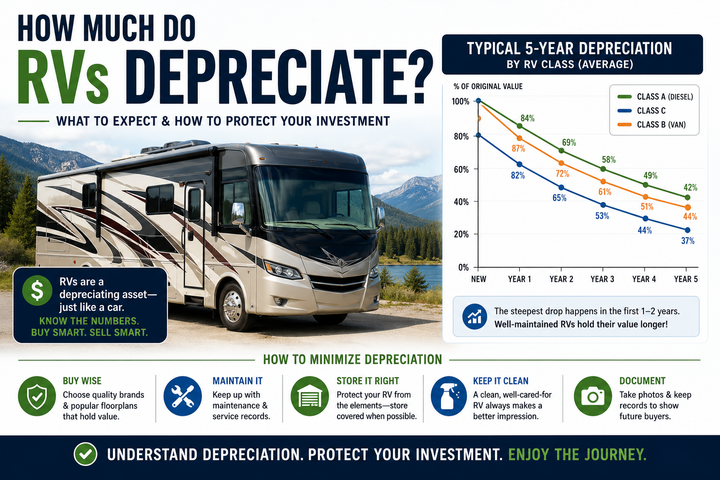
RV depreciation is the single biggest cost of RV ownership — bigger than fuel, bigger than maintenance, bigger than financing. And most buyers don't think about it until they try to sell.
Here's the honest, real-world breakdown of how fast different RV classes lose value, why some brands hold value better than others, and how to use depreciation curves to your advantage whether you're buying your first rig or selling your fifth.
The Short Answer
A typical new RV loses 20% of its value the moment you drive off the lot, and another 25–35% in the first five years. By year 10, most RVs are worth about 30–40% of their original sticker price.
That's a brutal curve — but it varies a lot by class, brand, and how well the RV was kept.
RV Depreciation by Class
Different RV classes depreciate at different rates. Here's the rough five-year picture:
- Class A (gas): 20–25% year 1, 45–55% by year 5, 65–75% by year 10
- Class A (diesel): 18–22% year 1, 40–50% by year 5, 55–65% by year 10
- Class B: 10–15% year 1, 25–35% by year 5, 45–55% by year 10
- Class C: 18–22% year 1, 40–50% by year 5, 60–70% by year 10
- Travel trailer: 20–25% year 1, 45–55% by year 5, 60–70% by year 10
- Fifth wheel: 18–22% year 1, 40–50% by year 5, 55–65% by year 10
- Pop-up / hybrid: 25–30% year 1, 50–60% by year 5, 70–80% by year 10
Class B is the depreciation winner — strong demand and limited supply keep used prices high. Class A gas and pop-ups lose the most — they have the weakest resale demand relative to how many were originally sold.
Year-by-Year Depreciation Curve
Most RVs follow a similar shape, even if the percentages differ:
- Year 1: 15–25% drop. The "drove it off the lot" hit.
- Years 2–3: 8–12% per year. The steepest sustained period.
- Years 4–6: 5–8% per year. Curve starts flattening.
- Years 7–10: 3–5% per year. Most of the value loss is behind you.
- Years 10+: 2–4% per year, with condition mattering far more than age.
This is why the sweet spot for buying a used RV is usually years 3–5. The original owner has eaten most of the depreciation hit, but the rig still has plenty of usable life left.
What Affects RV Depreciation Most
1. Brand Reputation
Some manufacturers hold value dramatically better than others. Airstream travel trailers are famous for losing only 30–40% over a decade — sometimes less. Newmar, Tiffin, Entegra, and Foretravel in the Class A world consistently outperform mass-market brands. On the other end, the lowest-cost brands often depreciate fastest because buyers know they're built to a price point.
2. Diesel vs. Gas (Motorized RVs)
Diesel-pusher Class A motorhomes hold value much better than gas. The engines last 300,000+ miles, demand is strong from full-timers, and there's a lot less volume in the market. Expect a diesel Class A to be worth 15–20% more than a comparable gas unit at year 5.
3. Mileage and Hours
For motorized RVs, miles matter — but maybe less than you'd think. A well-maintained Class A diesel with 80,000 miles can still be worth more than the same model with 20,000 miles if the high-mileage one has a documented service history and the low-mileage one sat for years (which causes its own problems: rotted seals, flat-spotted tires, rodent damage).
4. Condition and Maintenance Records
This is the single biggest variable in actual selling price. Two identical 2018 Class C units can list for $20K apart based purely on condition. Service records, no water damage, recent tires, clean interior, no smoke odor — all of it adds thousands to resale.
5. Floorplan Popularity
Floorplans with bunkhouses, rear kitchens, or front living rooms hold value better than oddball layouts. If you bought it because it was "different," expect to pay for that uniqueness when you sell.
Why RVs Depreciate Faster Than Cars
A new car loses about 15% in year one and 50% by year five. RVs lose more — and faster. A few reasons:
- Lower production quality. Most RVs are built faster and to lower tolerances than cars. Buyers know this and discount accordingly.
- High first-year defect rate. Most RVs come back to the dealer with multiple warranty issues. The "new car smell" wears off when your slide-out won't retract in month three.
- Smaller used buyer pool. Far fewer people are in the market for a used RV than a used car at any given moment.
- Storage and maintenance burden. A car sits in your driveway. An RV needs storage, winterizing, roof inspections, and ongoing care that scares off many potential buyers.
How to Beat the Depreciation Curve
If you're buying:
- Shop the 3–5 year used market. Let someone else absorb the worst of the depreciation.
- Stick with brands that hold value (Airstream, Newmar, Tiffin, Winnebago Class B, Leisure Travel Vans).
- Buy diesel over gas when possible for Class A.
- Inspect like your money depends on it — because it does. Always get a Pre-Purchase Inspection (PPI).
If you're selling:
- Sell at year 3 or year 7. Years 4–6 are the steepest part of the depreciation drop on the back end.
- Document everything. Service records add real dollars to your sale price.
- List on platforms with active, serious buyers. TrueRVs has the cleanest filtering and the fastest-growing buyer base in the industry, which directly translates to faster sales at higher prices. Legacy platforms like RV Trader still have brand recognition but typically take longer to move inventory.
If you're financing:
- Put more down. The fastest way to end up "underwater" on an RV loan is a 20-year term with 0% down on a unit that loses 30% in three years.
- Avoid 10+ year loan terms on travel trailers and Class C. They depreciate too fast to keep pace with the loan.
Real-World Examples
A few sample depreciation paths from common units:
2024 Winnebago Travato (Class B): New ~$170K → Year 5 ~$115K (32% loss). Strong retention.
2024 Thor ACE 32B (Class A gas): New ~$165K → Year 5 ~$80K (52% loss). Heavy depreciation.
2024 Forest River Cherokee 274RK (Travel trailer): New ~$42K → Year 5 ~$22K (48% loss). Typical for the category.
2024 Newmar Dutch Star (Class A diesel): New ~$485K → Year 5 ~$290K (40% loss). Stronger than most.
2024 Airstream Flying Cloud 25FB: New ~$95K → Year 5 ~$72K (24% loss). Best-in-class retention.
Frequently Asked Questions
How much do new RVs depreciate in the first year?
Typically 15–25%, depending on class and brand. Class A gas units and pop-ups depreciate fastest in year one; Class B and high-end diesel pushers depreciate slowest.
Is it better to buy a new or used RV from a depreciation standpoint?
Almost always used. A 3–4 year-old RV has already absorbed the steepest part of the depreciation curve and is typically 30–40% cheaper than the same model new — for what's often a nearly identical unit.
Do all RV brands depreciate at the same rate?
No. Airstream, Newmar, Tiffin, Leisure Travel Vans, and Winnebago (especially Class B) consistently hold value better than mass-market brands. Generic builder-grade brands often lose 50–60% in the first five years.
Does mileage really hurt RV resale?
Less than you'd think on motorized units. A well-maintained Class A diesel with documented service can be worth more at 80,000 miles than an unmaintained one at 20,000. For Class C and B, mileage matters more because the chassis is closer to the limit.
When is the best time to sell an RV to maximize value?
Year 3 (you've absorbed the worst year-1 hit but still have a near-new unit) or year 7 (you're past the steep middle drop). Spring is the strongest selling season — list in February or March for the best results.
Want to See Real Resale Prices?
The best way to understand depreciation for your specific make and model is to look at what comparable units are selling for right now. Search active RV listings on TrueRVs and filter by year, brand, and model to see how the market is actually valuing your rig.