RV Selling Scams in 2026: Fake Buyers, Escrow Fraud, and How to Close a Sale Safely
Samuel Atallah 10 min read
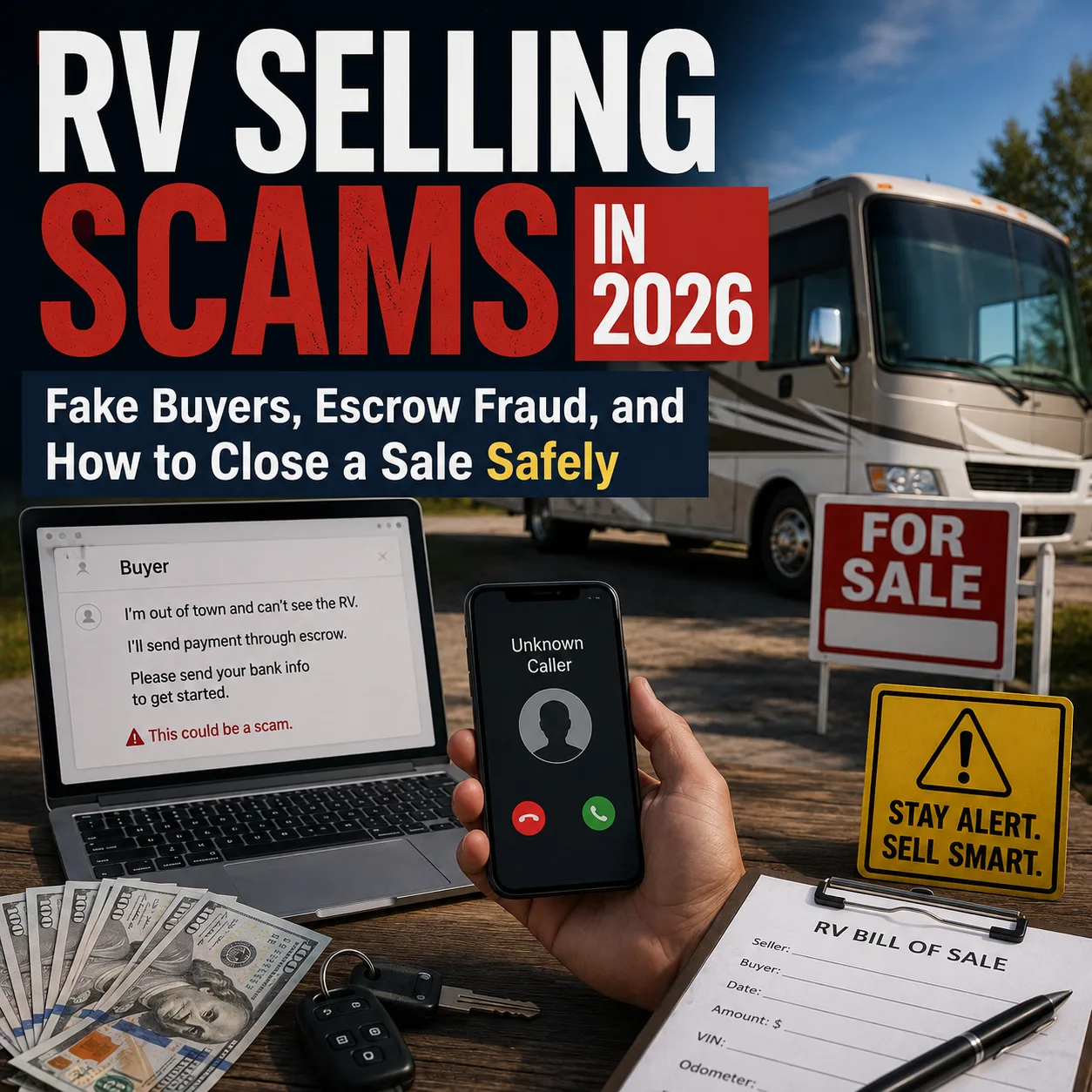
Table of contents
List a $60,000 fifth wheel online and the scammers usually beat the real buyers to your inbox — sometimes by hours. RVs are a favorite fraud target because the dollar amounts are high, the deals are private-party, and most sellers only do this once or twice in a lifetime. The scammer has run the play a thousand times more than you have.
The good news: nearly every scam aimed at RV sellers is a variation on a handful of scripts, and once you recognize them they're easy to shut down. The Federal Trade Commission has issued a specific alert about fake check scams targeting online vehicle sellers, and the FBI's Internet Crime Complaint Center logged over a million complaints and $20.9 billion in reported losses in its latest annual report. You don't want to be a line item in the next one.
This guide walks through the actual playbook scammers run on RV sellers, then gives you a safe-closing checklist that makes you a hard target. If you haven't listed yet, start with our complete step-by-step guide to selling your RV; this article covers the part where money changes hands.
The Scammer's Playbook: 7 Scams Aimed at RV Sellers
1. The Overpayment / Cashier's Check Scam
This is the oldest and still the most profitable. A "buyer" agrees to your price with little or no negotiation, then sends a cashier's check for more than the agreed amount — supposedly covering shipping or "the agent's fee" — and asks you to deposit it and wire or Zelle the difference to their shipper.
The mechanic that makes it work: federal rules require banks to make deposited funds available quickly — often within a day or two — but it can take weeks to discover the check is counterfeit. When it bounces, the bank claws the money back from you. The FTC has reported a median fake-check loss of nearly $2,000, and on an RV-sized deal it's far worse: you may have already handed over the rig, the title, and thousands in "refunded overpayment."
The rule: Never accept a check for more than the sale price, and never send money back to a buyer for any reason. There is no legitimate version of that transaction. Ever.
2. Fake Escrow Services
Escrow is a legitimate concept — a neutral third party holds the money until both sides perform. Scammers exploit that legitimacy with convincing fake escrow websites, sometimes cloning real companies' logos. The "buyer" insists on "their" escrow service, the site shows funds as "secured," you release the RV — and the funds never existed.
Red flags for fake escrow: the buyer chose the service and won't use any other; the site is only a few months old (check the domain registration); "customer support" exists only by email or chat; and the payment confirmation arrives as an email rather than money in an account you control. Legitimate escrow companies are licensed with state regulators — California's Department of Financial Protection and Innovation runs a searchable registry, and other states have equivalents. If you want escrow, you pick the company and verify its license before a dollar moves.
3. "I'll Buy It Sight Unseen — My Shipper Will Pick It Up"
Someone who wants to buy a $45,000 motorhome without seeing it, driving it, or having it inspected is not a buyer. This script usually combines with the overpayment scam: the extra money on the check is "for the transport company," which you're asked to pay directly. The transport company is the scammer's other email address.
Variants include the deployed soldier, the oil-rig worker, and the overseas missionary — anyone with a sympathetic reason they can't show up. Real long-distance RV buyers exist, but they behave differently: they ask detailed questions, hire an independent inspector they found, often fly in for pickup, and pay by verified wire before anything ships.
4. Phishing for Your Title, VIN, and Personal Info
Not every scam wants your money directly. Some "buyers" ask you to text photos of the title, your driver's license, or the VIN plate "so I can verify it's not stolen." A photographed title can be used to forge title documents; your license and address feed identity theft; a harvested VIN can be cloned onto a stolen rig of the same model.
Sharing the VIN itself so a serious buyer can run a history report is normal and reasonable. Sending images of the title, your license, or your registration to someone you've never met is not. The title gets signed once, in person, at closing, with payment verified.
5. The Fake "Pre-Purchase Inspection" or History Report Funnel
This one targets you within minutes of listing. A "very interested" buyer says they'll commit as soon as you provide a report or inspection from a specific website they link you to — one you've never heard of. The site charges $20–$40 for a worthless or nonexistent report, the buyer vanishes the moment you pay, and some versions harvest your card number for bigger fraud later. RV sellers report this constantly on owner forums.
The rule: A buyer who wants a history report pulls one themselves from a known provider using the VIN you supply. A buyer who wants an inspection hires and pays a mobile RV inspector directly. You never pay to prove your own rig to a stranger, and you never use a link a buyer sends you.
6. Payment App Reversals: The Zelle, Venmo, and Cash App Myths
Scammers love peer-to-peer payment apps for two opposite reasons. Zelle transfers are effectively instant and irreversible — great for them when you're the one sending "refunded overpayment." Meanwhile apps like Venmo and PayPal have dispute processes fraudsters abuse: they pay from a stolen account or dispute the charge after driving off, and the platform reverses the payment out of your balance. Several apps also prohibit vehicle-sized transactions in their terms, which can leave you with no protection at all.
A related trick: the fake payment screenshot, or the spoofed "payment pending — seller must upgrade to a business account" email asking you to cover a fee to release funds that were never sent. No real payment platform asks the recipient to pay to receive money.
The rule: P2P apps are for splitting dinner, not selling a motorhome. Use a wire transfer or in-person bank verification for five- and six-figure sales.
7. Title Games on the Buyer's Side
Occasionally the fraud comes after the handshake. A buyer may ask you to leave the buyer section of the title blank ("I'm reselling it"), sign a bill of sale showing a much lower price ("to save on taxes"), or skip required notarization. An open title means the RV stays legally yours — along with liability for tolls, accidents, and abandonment — until someone eventually registers it, and underreporting the price on official documents is tax fraud with your signature on it. Complete every field, keep copies, and file your state's release-of-liability form the day you sell.
The Safe-Closing Checklist
Screening out scammers is half the job. The other half is closing the legitimate sale in a way that can't be exploited.
Verify the Money Before Anything Else Moves
| Payment Method | Safety for Seller | How to Handle It |
|---|---|---|
| Wire transfer | Best for large sums | Confirm with your bank that funds have landed and are final — not just "pending" — before signing the title. Wires are effectively irrevocable once settled. |
| Cashier's check | Safe only if verified correctly | Call the issuing bank using a phone number you look up independently — never the number printed on the check, which can be fake too. Better: meet at a branch of the issuing bank and have them cut or verify it in front of you. |
| Cash | Fine for smaller amounts | Count it inside a bank, have a teller run it through a counter, and deposit immediately. |
| Licensed escrow | Good for long-distance deals | You choose the company, verify its state license, and confirm funds directly with the escrow officer by phone — not by email. |
| Zelle / Venmo / Cash App / personal check | Avoid | Reversal risk, platform limits, and no protection for vehicle sales. Decline politely and offer a wire instead. |
Close at the Bank, Not Your Driveway
The cleanest RV closing in America happens in a bank lobby during business hours. Meet at the buyer's bank (or the issuing bank for a cashier's check): the buyer gets the check cut or the wire initiated while you watch, a banker confirms it's genuine, and you sign the title in a building full of cameras and witnesses. A buyer who refuses to close at a bank on a five-figure purchase has answered your question.
Paper the Deal
- Bill of sale — two signed copies listing the VIN, year/make/model, odometer or hour reading, actual sale price, "sold as-is," and both parties' names and addresses. Some states require notarization.
- Title transfer — every field completed, signed exactly as your name appears, lien release attached if you've paid off a loan.
- Release of liability — filed with your DMV the same day.
- Insurance — keep yours active until the rig and title have both changed hands, then cancel.
And the golden rule that defeats nearly every scam on this list: the RV and the signed title do not leave your possession until the funds are final. Not "deposited." Not "showing in the app." Final, confirmed by a human at your bank.
If You've Already Been Scammed
Act fast — the first hours matter. Call your bank immediately to attempt a wire recall or stop payment. Then report to the FBI at IC3.gov and the FTC at ReportFraud.ftc.gov, and file a local police report (the bank and your insurer will need it). If your title or license was photographed, freeze your credit with all three bureaus. Wire recalls sometimes succeed when reported within 24–72 hours, and your report helps investigators tie the ring to other victims.
Where You List Matters Too
Scam pressure varies by venue. Free classified sites with anonymous messaging attract the highest scam volume; marketplaces built around vehicle listings filter more of it before it reaches you. We break down the trade-offs in our guide to where to sell your RV in 2026. Wherever you list, keep early communication inside the platform's messaging system — pushing you instantly to text or personal email is a scammer's first move, because it takes them out of view of the platform's fraud filters.
Frequently Asked Questions
Is a cashier's check safe when selling an RV?
Only if you verify it correctly. Counterfeit cashier's checks look real and can clear initially, then bounce weeks later — leaving you repaying the bank. Verify by calling the issuing bank at a number you look up yourself, or better, meet the buyer at a branch of the issuing bank and watch the check get cut or confirmed before signing anything.
What's the safest way to accept payment for an RV?
A wire transfer confirmed as settled by your own bank is the safest method for five- and six-figure RV sales. Close at a bank during business hours, keep the title in your pocket until a banker confirms the funds are final, and only then sign it over. Cash works for smaller amounts if counted and deposited at a teller window.
How can I tell if an escrow service is fake?
Fake escrow sites are usually chosen by the buyer, recently registered, reachable only by email or chat, and they "confirm" payment via email rather than funds you can verify. A legitimate escrow company is licensed with a state regulator, has a verifiable physical address and phone line, and lets you confirm the deposit directly with an escrow officer. If you use escrow, you choose the company.
Should I accept Zelle or Venmo for an RV sale?
No. Zelle offers essentially no purchase protection — it's designed for sending money to people you know and trust. Venmo, Cash App, and PayPal payments can be disputed or reversed if the account was stolen, and vehicle-sized transactions may violate the platforms' terms, voiding any protection. Politely decline and offer a bank wire or an in-bank closing instead.
When should I sign over the title to the buyer?
Only after payment is verified and final — meaning your bank confirms a settled wire, or the issuing bank confirms a cashier's check in person. Never release the title or the RV against a pending deposit, a payment app screenshot, or an escrow email. Complete every field on the title, keep copies, and file your state's release-of-liability form the same day.
What should I do if I got scammed selling my RV?
Contact your bank immediately to attempt a wire recall or stop payment — speed matters most in the first 24–72 hours. Then file reports with the FBI at IC3.gov, the FTC at ReportFraud.ftc.gov, and your local police department. Save every message, email, check image, and phone number; investigators use these to link cases, and your bank will require the police report.
The best defense, though, is a marketplace full of real buyers. TrueRVs lets private sellers list, reach serious RV shoppers nationwide, and keep 100% of the sale price — no commissions, no consignment games. List your RV on TrueRVs and close your sale on your terms, with the checklist above in your back pocket.