RV Dealer Marketing: The 2026 Playbook That Actually Sells Units
TrueRVs Team 4 min read
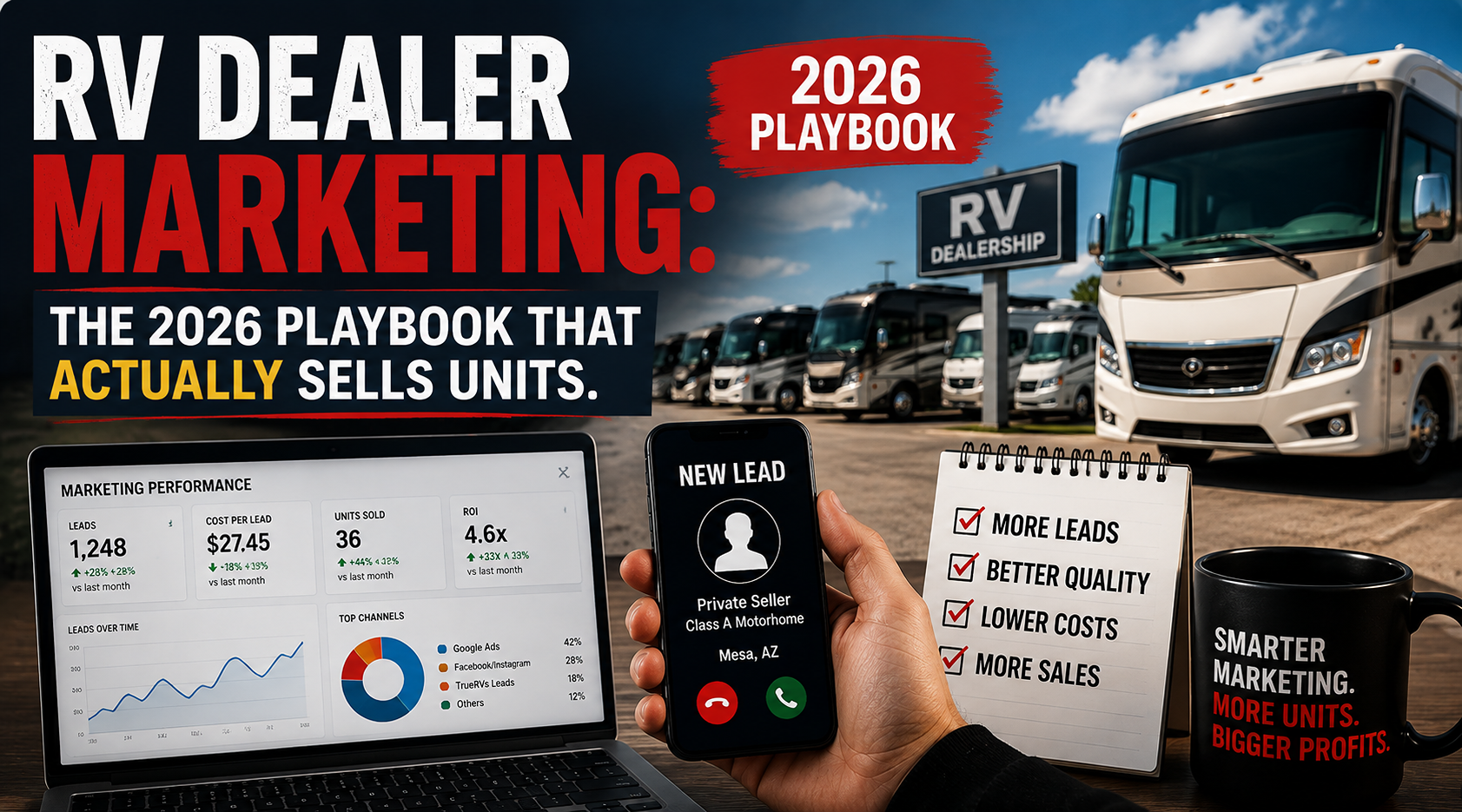
Most RV dealer marketing advice is recycled from car dealerships circa 2015: run some radio, boost some Facebook posts, buy the biggest package on the big listing site, and hope. Meanwhile, margins are tighter than they've been in years, floor plan costs are real, and every aged unit on your lot is burning money.
This is a practical playbook for what's working in RV dealer marketing right now, organized by what to fix first.
Start with the math, not the channels
Before spending another dollar, know three numbers for your store:
Cost per sold unit by channel. Total monthly spend on each channel divided by units sold that you can trace to it. Average days on lot. Marketing that moves aged units is worth more than marketing that sells your hottest floor plan, because that unit sells itself. Lead response time. The average minutes between a lead arriving and a human responding.
Most dealerships that feel "marketing isn't working" actually have a response-time problem or an aged-inventory problem wearing a marketing costume.
The channel hierarchy for RV dealers in 2026
- Marketplace presence (highest intent)
Shoppers on RV marketplaces are there to buy. Nowhere else in your funnel is intent that concentrated. Your priorities:
Every unit listed, every listing complete. Real photos (not stock), real price (not "call"), full specs. Listings with prices and 20+ photos dramatically outperform sparse ones. Be early on growing platforms. On legacy sites you're one of tens of thousands of units, paying premium rates for placement. On newer marketplaces like TrueRVs, with 11,000+ RVs and growing, early dealer inventory gets outsized visibility while the competition is still asleep. Let matching do the selling. TrueRVs' AI Shopper interviews buyers about budget, tow vehicle, family size, and use case, then routes them to specific matching units. That's marketing you don't have to run: your inventory is the ad, shown to exactly the person hunting for it. 2. Your website and local SEO Claim and fully build out your Google Business Profile; most "RV dealer near me" clicks go to the map pack, not websites. Make sure your inventory pages are indexable and each unit has its own URL with year/make/model in the title. Publish a page per major brand and type you carry ("Jayco dealer in [city]," "fifth wheels for sale in [state]"). 3. Paid social, for units, not vibes
Brand-awareness ads are how dealerships burn budget. What works: carousel and video ads featuring specific units with visible prices, targeted within your delivery radius, plus retargeting for everyone who visited your inventory pages. Feature your aged units. The marketing job is moving what doesn't move itself.
- Email and SMS, the neglected goldmine
Your CRM is full of past buyers and dead leads. RV owners upgrade, downsize, and refer friends. A monthly email with new arrivals and a "we buy RVs / trade-ins welcome" note is nearly free and consistently produces deals.
- Video and social content
Walkthrough videos sell RVs. One person with a phone doing honest 3-minute unit tours, posted to YouTube, Facebook, and TikTok with the price in the first 10 seconds, outperforms polished brand content every time.
What's genuinely new in 2026
The biggest shift in RV dealer marketing isn't a channel. It's matching replacing broadcasting. Instead of paying to show your inventory to everyone and hoping the right buyer scrolls past, AI-driven marketplaces route individual buyers to individual units.
That's the model TrueRVs is built on, and we're extending it with dealer promotion tools that haven't existed in this industry before: new ways to put specific units in front of matched, in-market shoppers. Early dealer partners get first access as these roll out, before they're available broadly.
A 90-day plan you can actually run
Days 1 to 30: Fix the foundation. Price every unit publicly, complete every listing, set a 15-minute lead response standard, claim your Google Business Profile.
Days 31 to 60: Expand distribution. Get full inventory onto a growing marketplace, launch retargeting ads on your site traffic, start weekly walkthrough videos.
Days 61 to 90: Measure and cut. Pull cost per sold unit by channel, kill the bottom performer, reinvest in the top two.
Frequently asked questions
How much should an RV dealership spend on marketing? Common benchmarks run 1 to 2% of gross revenue or a few hundred dollars per unit sold, but the honest answer is: whatever your cost-per-sold-unit math supports. Channels should earn their budget monthly.
What's the highest-ROI marketing move for a small dealership? Complete listings with real prices on marketplaces, plus sub-15-minute lead response. Neither costs meaningful money; both move close rates immediately.
How do I market aged inventory? Feature it, don't hide it. Price it visibly, put it in your paid social rotation, and list it where matching algorithms can pair it with the right buyer instead of waiting for a walk-in.
Want your inventory marketed in ways your competitors haven't seen yet?
TrueRVs pairs your units with AI-matched buyers, and our early dealer partners get first access to promotion tools that are new to the entire industry.
Email business@truervs.com to get your inventory on TrueRVs.