Should You Trade In Your RV or Sell It Privately? (Real Numbers)
TrueRVs Team 6 min read
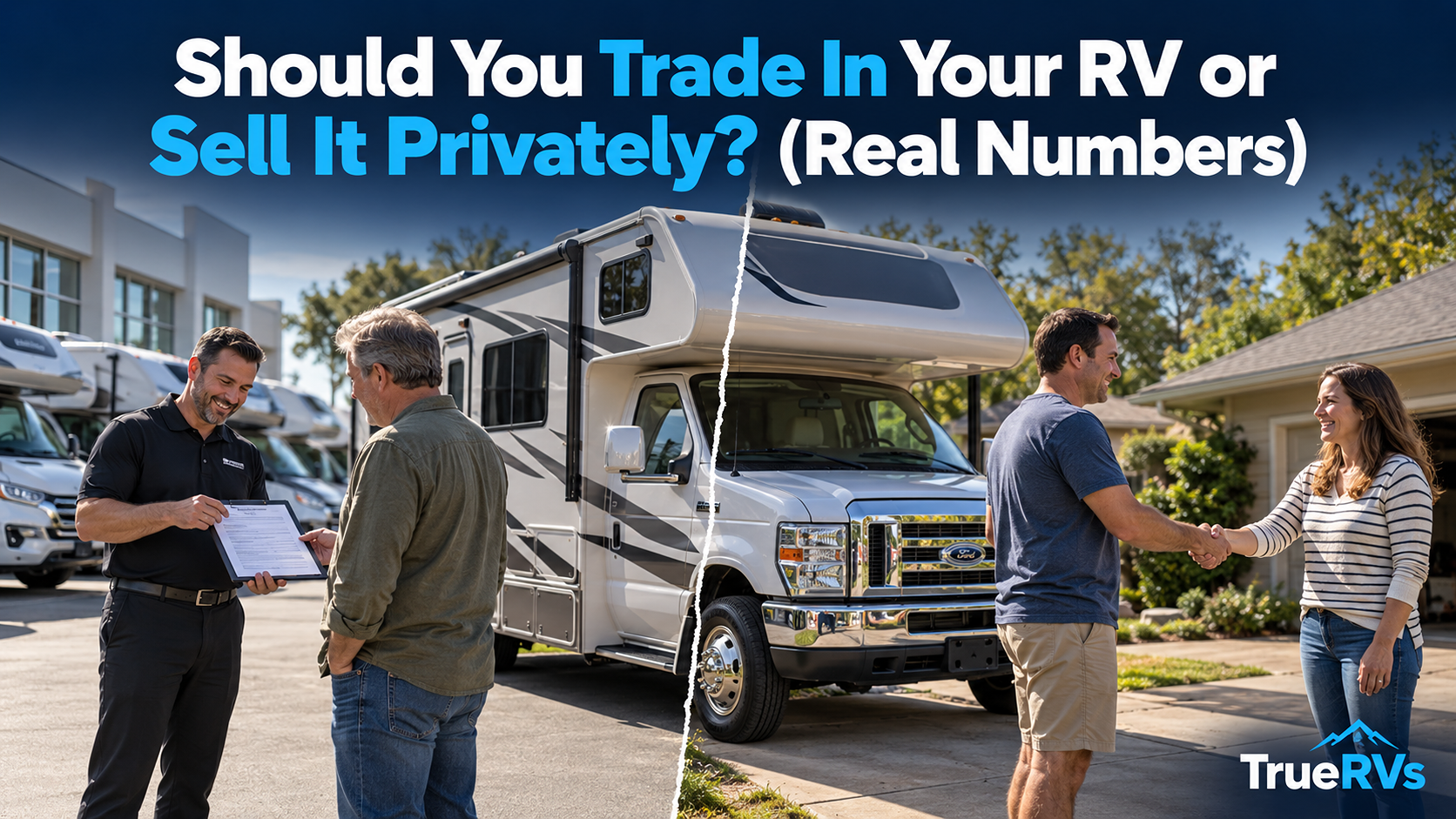
Table of contents
Should You Trade In Your RV or Sell It Privately? (Real Numbers)
Selling your RV privately typically brings 15 to 30 percent more than trading it in at a dealership. On a $40,000 RV, that is $6,000 to $12,000 in your pocket for a few weeks of effort. A trade in is faster, simpler, and can lower the sales tax on your next RV in most states, but you pay for that convenience with a much lower number. For most owners with a clean, working RV, selling privately wins. For owners who need out fast or have a problem unit, the trade in can be the right call.
Here is how the math works, the tricks to watch for at the dealership, and how to decide.
How Much Less Does a Dealer Pay on a Trade In?
Dealers typically offer 60 to 80 percent of what your RV would bring in a private sale. That gap exists because the dealer has to recondition the RV, pay to keep it on the lot, market it, and still make a profit when it sells. A dealer who thinks your travel trailer will retail for $30,000 might offer $20,000 to $23,000 on trade.
That is not the dealer being unfair. It is the cost of them taking the risk and the work off your hands. The question is whether that convenience is worth $7,000 to $10,000 to you. For most people who can spare a few weeks, it is not.
Trade In vs Private Sale: A Real Example
Take a 2020 travel trailer in good condition.
| Trade In | Private Sale | |
|---|---|---|
| Typical value | $22,000 | $30,000 |
| Time to complete | Same day | 2 to 4 weeks |
| Your effort | Sign paperwork | Photos, listing, showings |
| Sales tax savings on next RV (7% state) | $1,540 | $0 |
| Net to you | $23,540 | $30,000 |
| Difference | $6,460 more by selling privately |
Even after the sales tax credit, the private sale comes out $6,460 ahead. On a $60,000 fifth wheel the gap is often $10,000 to $15,000. On a $150,000 diesel motorhome it can exceed $25,000. The bigger the RV, the more a trade in costs you.
The Trade In Tricks Dealers Use
Dealers know that most buyers focus on the trade number and lose track of the total deal. Three moves are common.
The inflated trade, shrunken discount. The dealer gives you a strong trade value, sometimes above market, and quietly gives you less discount on the new RV. Your trade looks great but your total out of pocket is the same or worse. Always negotiate the new RV price first, in writing, before you mention a trade.
The payment focus. The salesperson steers the conversation to monthly payment instead of price. A low payment can hide a low trade value, a high price, and a longer loan term all at once.
The negative equity roll. If you owe more than the trade is worth, the dealer offers to roll the difference into your new loan. It feels painless, but you are now paying interest on an RV you no longer own, sometimes for 15 years. Selling privately and covering the gap with cash almost always costs less over time. We covered how to handle that in how to sell an RV with a loan on it.
When a Trade In Makes Sense
A trade in is the right call in a few specific situations. You need the RV gone this week because of a move, a health issue, or a financial deadline. The RV has a significant problem, like water damage or a mechanical issue, that would make a private sale slow and stressful. You live somewhere remote with very little private buyer traffic. You are buying from a dealer who is offering an unusually strong trade value with a fair price on the new unit, which happens when they need your specific model for inventory. Or the RV is worth so little that the private sale gap is a few hundred dollars and not worth your Saturday.
If one of those fits, take the trade and do not look back.
When Selling Privately Makes Sense
Selling privately is the right call for most owners with a clean, functioning RV worth more than $10,000. That includes anyone who can wait two to four weeks, anyone who is not buying their next RV from a dealer, and anyone whose RV is in a popular category like a bunkhouse travel trailer, a mid size fifth wheel, or a Class B or Class C motorhome where the buyer pool is large.
The effort is smaller than it sounds. Wash the RV, take 25 or more daylight photos with the slides open, write a complete listing with every spec and an honest condition note, price it against live comparables, and list it where real buyers are shopping. On a modern marketplace with buyer matching, well presented RVs are selling in 7 to 31 days. Our guide to how long it takes to sell an RV breaks down the timelines by method.
What About Selling to a Dealer for Cash?
There is a middle option: selling outright to a dealer without buying anything. Dealers, and the national RV buying services that advertise fast cash offers, will usually pay slightly more than a trade in because there is no new sale to hide the number in, but still well below private sale value. Expect 70 to 85 percent of private market. It takes one to two weeks and involves an inspection. It is a reasonable choice if you want speed without a new RV purchase, and it is a bad choice if your RV is in demand and would sell privately in a couple of weeks anyway.
How to Get the Most for Your RV
If you decide to sell privately, four things drive the price. Price it against real comparable listings, not against what you owe or what you paid. Present it better than the listings around it: more photos, better light, complete specs, and a video walkthrough. List where the buyers are. And answer messages fast, because buyers message several sellers at once.
On TrueRVs, your listing is matched to buyers by budget, floor plan, and towing setup through the AI Shopper, so the people seeing it are looking for exactly what you have. Seller Shield blocks the scammers and lowballers, and the top packages stay live until sold. That combination is why sellers who were quoted a trade number are often surprised by how quickly a private listing beats it. Before you list, check what your RV is worth in 2026 so you price it right from day one.
Frequently Asked Questions
Is it better to trade in an RV or sell it? Selling privately almost always nets more, typically 15 to 30 percent, even after accounting for sales tax savings on a trade. Trading in is better only when you need speed, the RV has problems, or the value is too low to bother.
How much do dealers give for RV trade ins? Usually 60 to 80 percent of private sale value. The dealer needs room for reconditioning, lot costs, marketing, and profit.
Do you save on sales tax when you trade in an RV? In most states, yes. Sales tax on the new RV is charged on the price minus the trade value. On a $20,000 trade at 7 percent tax that saves $1,400. It rarely closes the gap with a private sale.
Can I trade in an RV I still owe money on? Yes, but if you owe more than the trade value the dealer rolls the difference into your new loan and you pay interest on it. Selling privately and paying the gap in cash usually costs less over time.
How long does it take to sell an RV privately vs trade in? A trade in is same day. A private sale on a marketplace with real buyer traffic is 7 to 31 days for a well priced, well presented RV. On older listing sites it can take one to three months.
Should I fix my RV before trading it in or selling it? Fix small, cheap things either way: a dead battery, a torn screen, a burned out light. Do not do major repairs before a trade in, because the dealer will not pay you back for them. Before a private sale, a professional inspection report and receipts for recent work can justify a stronger price.
Before you take the trade number, see what your RV brings on the open market. List it on TrueRVs and let real buyers make the offer.