RV Consignment vs. Selling It Yourself: Fees, Timelines, and the Real Math (2026)
TrueRVs Team 7 min read
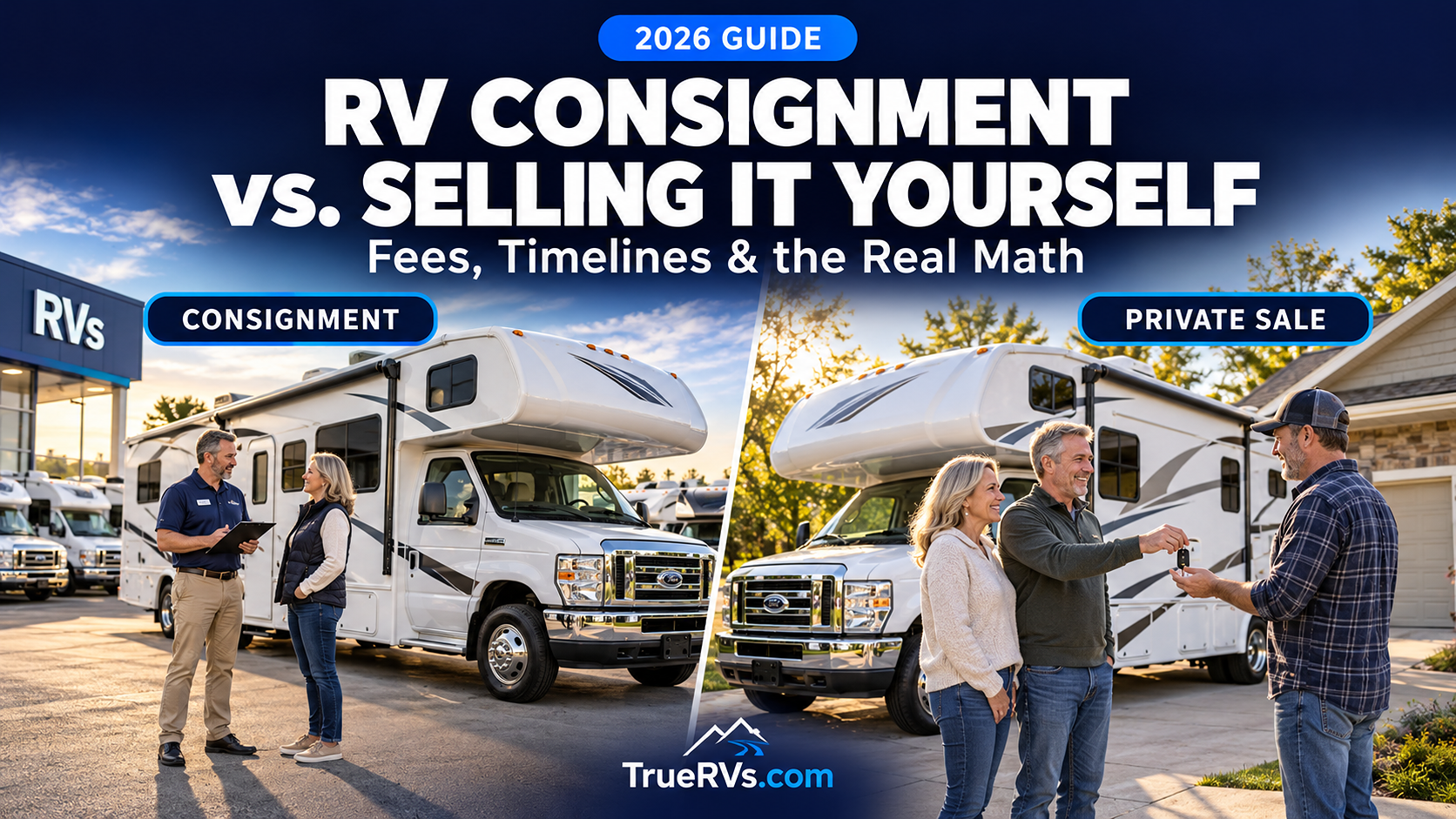
Table of contents
- How RV Consignment Works
- What Does RV Consignment Cost?
- How Long Does Consignment Take?
- Consignment vs. Private Sale vs. Trade In
- The Real Math on a $50,000 RV
- When RV Consignment Makes Sense
- When Selling Privately Makes More Sense
- What Happens If Your RV Does Not Sell on Consignment?
- Questions to Ask Before You Sign a Consignment Agreement
- A Faster Way to Sell It Yourself
- Frequently Asked Questions
RV Consignment vs. Selling It Yourself: Fees, Timelines, and the Real Math (2026)
RV consignment means a dealer sells your RV for you and keeps a fee, usually 10 to 20 percent of the final sale price or a flat fee, while you keep ownership until it sells. It takes the work off your plate, but it costs more than selling privately and is often slower, with typical consignment periods of 30 to 90 days. On a $50,000 RV, consignment can cost $5,000 to $10,000 more than a private sale that brings the same price.
Consignment is not a bad option. For some sellers it is the right one. But it pays to know exactly what you are giving up before you sign a consignment agreement.
How RV Consignment Works
- You bring the RV to a dealer or consignment lot. They inspect it and agree on a listing price with you.
- You sign a consignment agreement. It spells out the fee, the term, who pays for storage, insurance, and reconditioning, and what happens if it does not sell.
- The dealer markets and shows the RV. It sits on their lot and appears in their online inventory.
- A buyer purchases it. The dealer handles financing, paperwork, and the title transfer.
- You get paid. The dealer deducts their fee and any agreed costs, pays off your loan if you have one, and sends you the rest, usually within a few business days to a couple of weeks.
What Does RV Consignment Cost?
Consignment fees vary by dealer, but most fall into one of these structures:
| Fee Structure | Typical Range | What It Means on a $50,000 Sale |
|---|---|---|
| Percentage of sale price | 10 to 20 percent | $5,000 to $10,000 |
| Flat fee | Set by the dealer based on the RV's value | Often several thousand dollars |
| Net price agreement | Dealer keeps anything above your number | Varies, often more than a percentage |
Then watch for the add ons:
- Reconditioning or detail fees to get the RV lot ready
- Inspection or safety check fees
- Storage fees if the RV sits past a set period
- Early withdrawal fees if you take the RV back before the term ends
- Insurance, which usually stays your responsibility while it is on the lot
Read every line of the agreement. Two consignment offers with the same headline percentage can net you very different amounts once the add ons are included.
How Long Does Consignment Take?
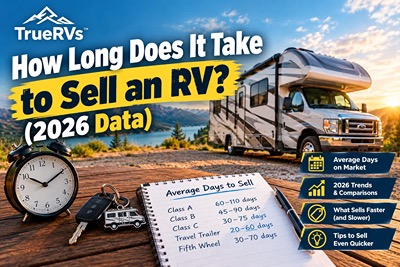
A well priced RV on consignment often sells in 30 to 60 days, and some dealers report averages closer to three or four weeks. Agreements usually run 60 to 120 days. If the RV does not sell in that window, you either extend, drop the price, or take it back and pay any fees owed.
The lot also controls how your RV is presented. Your rig may be one of hundreds of units, and the dealer's sales team is paid more to sell their own inventory than yours.
Consignment vs. Private Sale vs. Trade In
| Trade In | Consignment | Private Sale | |
|---|---|---|---|
| Price you get | 65 to 80 percent of retail | 80 to 90 percent after fees | 90 to 100 percent |
| Time to sell | 1 to 2 days | 30 to 90 days | 7 to 60 days |
| Your effort | Very low | Low | Moderate |
| Who handles buyers | Dealer | Dealer | You |
| Who handles paperwork | Dealer | Dealer | You and the buyer |
| Ongoing costs while selling | None | Insurance, possible storage | Insurance |
| Control over price | None | Shared | Full |
The Real Math on a $50,000 RV
Assume the same RV, in the same condition, with a market value of about $50,000.
Trade in: the dealer offers $37,000 to $40,000 toward a new RV. Fast and easy, but you leave $10,000 or more on the table.
Consignment at 15 percent: it sells for $48,000. The dealer keeps $7,200, plus a $500 detail fee. You net about $40,300, and it took seven weeks.
Private sale: it sells for $48,000 to a buyer you found online. After a listing fee and a couple of hours of showings, you net roughly $47,800, and on a modern marketplace with buyer matching it can sell in two to four weeks.
The difference between consignment and selling it yourself in this example is about $7,500. That is a lot of money for not answering a few messages.
When RV Consignment Makes Sense
Consignment is worth the fee if:
- You live far from where the RV is, or cannot be there for showings.
- You have no time at all to answer messages or meet buyers.
- The RV is very high end and benefits from a specialized dealer with buyers who finance through them.
- You are uncomfortable handling payment and paperwork with a stranger.
- The RV is a project or has issues that a dealer can recondition and sell more easily.
When Selling Privately Makes More Sense
Sell it yourself if:
- You want the most money from your RV.
- You can spare a few hours for photos, a listing, and a few showings.
- The RV is in good condition and priced fairly.
- You want control over the price, the buyer, and the timing.
Most of the work in a private sale happens once, when you take the photos and write the listing. After that, it is answering serious buyers and setting up a showing or two. Our step by step guide on how to sell an RV privately walks through it.
What Happens If Your RV Does Not Sell on Consignment?
This is the part of consignment most sellers do not think about until it happens. If the term ends without a sale, you usually have three choices: extend the agreement, lower the price, or take the RV back. Taking it back can trigger fees for reconditioning, storage, or early withdrawal, depending on the contract, and you are back where you started with an RV that is now a few months older and listed as previously unsold.
Some dealers will also make an offer to buy the RV outright at that point, which is often close to a trade in number. That can be fine if you need out, but it means you paid with time and fees to end up at roughly the same place a trade in would have put you on day one.
Before you sign, ask what happens at day 60, day 90, and day 120, and get the answers in writing. A clear exit plan is as important as the fee.
Questions to Ask Before You Sign a Consignment Agreement
- What is the fee, and is it a percentage, a flat fee, or a net price agreement?
- What other fees could come out of my proceeds?
- How long is the term, and what happens if it does not sell?
- Can I take the RV back early, and what does that cost?
- Who insures the RV while it is on the lot, and does your policy cover theft or damage?
- Where and how will it be advertised?
- Can I approve or reject offers below a certain number?
- How fast will I be paid after the sale?
- Is the dealer licensed and bonded in this state?
If the answers are vague, keep looking. A good consignment dealer puts everything in writing.
A Faster Way to Sell It Yourself
The biggest reason people choose consignment is that they do not want to deal with scammers, tire kickers, and endless messages. That is exactly what TrueRVs was built to fix. The AI Shopper matches your listing to buyers already searching for your type, budget, and floor plan, and Seller Shield screens every message so only real buyers reach you. You keep control of the price and keep the money a consignment fee would have taken.
Not sure what to ask for it? Start with how much your RV is worth in 2026, then compare every option in the best place to sell your RV.
Frequently Asked Questions
What is a typical RV consignment fee? Usually 10 to 20 percent of the final sale price, or a flat fee based on the RV's value, plus possible detail, storage, or inspection fees.
Is it better to consign or sell an RV privately? Selling privately almost always nets more money. Consignment makes sense when you cannot be available for showings or do not want to handle buyers and paperwork.
How long do RVs sit on consignment? Often 30 to 60 days for a well priced unit, with agreements commonly running 60 to 120 days.
Do I still need insurance while my RV is on consignment? Usually yes. Confirm in writing who covers theft and damage while it is on the lot.
Can I consign an RV that I still owe money on? Yes. The dealer pays off your lender from the sale proceeds and sends you the remaining equity.
Keep the consignment fee in your pocket. List your RV on TrueRVs and let real buyers come to you.