RV Consignment: How It Works, What Dealers Really Charge, and When It Costs You Thousands
Consignment dealers typically keep 10–15% of your sale price — plus storage, prep, and doc fees hiding in the contract. Here's how consignment really works, the honest math on a $60k fifth wheel across all three selling routes, the red flags to watch for, and when it's genuinely worth it.

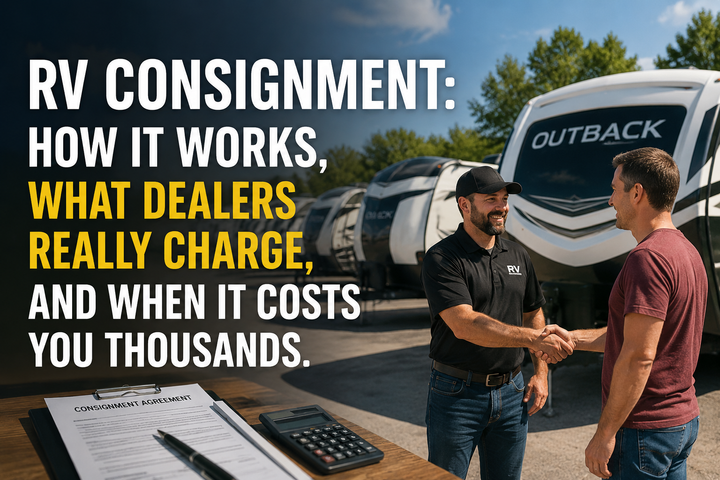
RV consignment gets pitched as the effortless middle path: more money than a trade-in, less hassle than selling it yourself. Drop the rig at a dealer's lot, let their sales team work, collect a check. And sometimes it plays out exactly that way — consignment genuinely earns its keep for certain owners and certain rigs.
But "effortless" has a price tag, and it's bigger than most sellers realize when they sign. Between the commission, the prep and storage fees buried in the contract, and the quiet reality that a dealer negotiating with your money on the table has little reason to hold firm on price, consignment routinely costs owners $5,000 to $10,000 on a mid-priced rig compared to selling it themselves.
This guide breaks down how consignment actually works, what dealers really charge in 2026, what the contract fine print commits you to, and the honest math on when it's worth it — and when it's just an expensive way to avoid answering messages from buyers.
How RV Consignment Actually Works
In a consignment deal, you remain the legal owner while a dealer takes physical possession of your RV and sells it on your behalf. The dealer stores it on their lot, photographs and lists it, fields inquiries, runs showings and test drives, negotiates with buyers, and handles closing paperwork. When it sells, the dealer deducts their cut and sends you the balance.
The appeal is real: the RV sits on a retail lot with foot traffic, a sales staff, and financing on site — dealers can close buyers who need a loan, which is a genuine advantage on higher-priced units. You do essentially nothing after drop-off. But you also give up control of the negotiation, you typically can't use the RV during the contract, and every dollar of convenience comes out of your sale proceeds.
What Dealers Really Charge
Fee structures vary more than dealers like to admit, but they cluster into four models.
Percentage commission
The most common arrangement: the dealer keeps a percentage of the final sale price, typically 10–15%, with some operations advertising as low as 8% and some high-touch or low-priced-unit programs pushing higher. On a $60,000 fifth wheel, a 12% commission is $7,200 — before any add-on fees.
Flat fee
Some dealers charge a fixed amount regardless of sale price — often a few thousand dollars. Flat fees can favor you on expensive coaches (a $3,500 flat fee on a $150,000 diesel pusher beats 12%) and punish you on cheaper units, where the flat fee can exceed what a percentage would have been.
Tiered or split structures
A hybrid: perhaps 15% on the first $30,000 and 10% above it, or a flat fee plus a smaller percentage. Read these carefully and run your specific number — tiered structures are usually designed to look better than they compute.
The "anything above X is ours" agreement
Here you set a guaranteed minimum — say $52,000 — and the dealer keeps everything above it. This sounds seller-friendly because your number is locked. In practice, it hands the dealer maximum incentive to lowball your floor when setting the agreement and maximum margin when selling. If they retail the rig at $61,000, they made $9,000 — roughly 15% — and you'll never see the final sale price unless the contract requires disclosure. If a dealer pushes hard for this structure, ask what they think the RV will actually retail for, then ask why you shouldn't just list it at that number yourself.
On top of any structure, watch for stacked fees that appear in the paperwork rather than the pitch: inspection or appraisal fees (typically $100–$300), marketing fees ($100–$500 if not folded into the commission), monthly storage charges if the unit sits unsold (often $50–$200), detailing and make-ready work billed to you, and documentation or transfer fees at closing ($50–$200).
What the Contract Actually Says
The consignment agreement is where the real terms live. Before signing, understand five clauses.
Exclusivity period. Most contracts run 30 to 90 days, and during that window you cannot sell the RV yourself — even to your neighbor who's wanted it for years. Some contracts still owe the dealer their commission if you find the buyer during the term. Check the renewal language too: many agreements auto-renew unless you cancel in writing.
Insurance while it sits on their lot. Do not assume the dealer covers your RV. Many contracts make insurance the owner's responsibility, and your standard policy may not cover a unit consigned for commercial sale — some insurers require a specific consignment endorsement. Get, in writing, who covers theft, hail, lot damage, and test-drive accidents. An uninsured week on a dealer lot during storm season is a five-figure gamble.
Storage, prep, and reconditioning fees. Some dealers store consigned units free; others charge monthly after a grace period. Almost all will recommend detailing, roof resealing, or repairs to make the unit "retail ready" — at your expense. Reasonable prep helps the sale, but require written approval for any charge above a set dollar amount.
What happens if it doesn't sell. This is the clause sellers skip and regret. Do you owe marketing, storage, or prep fees even if the RV never sells? Can you retrieve it mid-contract, and is there an early-termination fee? A contract where an unsold RV still costs you $800 in fees is not a no-risk arrangement.
Price authority. Who approves a price drop? Who accepts an offer? Insist on language requiring your written approval for any sale below an agreed floor. Remember the incentive problem: a dealer earning 12% loses just $240 of commission when they knock $2,000 off your price to close a deal faster. You lose $1,760.
The Real Math: A $60,000 Fifth Wheel, Three Ways
Say your fifth wheel's realistic private-party value is $60,000. Here's how the three exit routes typically compare. Numbers are illustrative and use typical mid-range fees; your quotes will vary.
| Trade-in | Consignment | Private sale | |
|---|---|---|---|
| Sale/offer price | $48,000–$52,000 (wholesale) | $57,500 (dealer negotiates down) | $58,500–$60,000 |
| Commission | — | −$6,900 (12%) | $0 |
| Prep/storage/doc fees | — | −$400–$900 | — |
| Your selling costs | $0 | $0 | −$100–$300 (detail, listing extras) |
| Typical net to you | $48,000–$52,000 | ~$49,700–$50,200 | ~$58,200–$59,900 |
Two things jump out. First, consignment often nets barely more than a good trade-in offer once fees stack — and a trade-in is instant, while consignment can take months. Second, the private sale wins by roughly $8,000–$10,000. That's the price of not wanting to take photos and answer messages. We've broken down the trade-in side of this in detail in trade-in vs. private sale: why selling yourself puts thousands more in your pocket.
One honest caveat: dealer financing sometimes gets consignment buyers to a slightly higher price than a cash-constrained private buyer would pay. On most mid-priced units, that bump doesn't come close to covering the commission.
When Consignment Genuinely Makes Sense
Consignment isn't a scam; it's a service with a steep price that's occasionally worth paying. It earns its fee when:
- You're nowhere near the RV. Full-timers who flew home, inheritors of a rig three states away, snowbirds whose coach is at the wrong end of the country. If you physically can't show it, someone has to.
- You're selling a high-end coach. Buyers of $200,000+ diesel pushers often want dealer inspections, financing, and a professional closing. A flat-fee consignment on an expensive unit can be a small percentage of the price.
- You truly have no time — and the math still works. If your realistic private-sale premium is $7,000 and you'd rather lose it than spend a few weekends on the sale, that's a legitimate choice. Just make it knowingly, with the number in front of you.
Red Flags in Consignment Dealers
- Verbal promises that aren't in the contract. "We never charge storage" means nothing unless the agreement says it.
- No clear insurance answer. A dealer who can't tell you in writing who covers lot damage has already told you.
- Pressure toward a guaranteed-minimum deal with a floor well below your research says the RV is worth.
- A lot full of aging consignments. Dozens of weathered units with old price stickers means slow turnover — and slow turnover means storage fees and stale listings.
- Commission owed even if you cancel or find your own buyer, or long auto-renewing terms with steep exit fees.
- Vague sale reporting. You should be entitled to see the final buyer's purchase price, not just your check.
Questions to Ask Before You Sign
- What is the total, all-in cost if it sells at asking price — commission plus every fee?
- What do I owe if it doesn't sell? Can I pull it out early, and what does that cost?
- Who insures the RV on your lot and during test drives — and can I see that in writing?
- What's your average days-to-sale for units like mine, and what did the last three comparable units actually sell for?
- Do I approve price reductions and final offers in writing?
- Will I see the actual final sale price?
A good consignment dealer answers all six without flinching. Hesitation on any of them is your answer.
The Free-Listing Alternative
The reason consignment persists is that owners assume the alternative is nothing but hassle. It isn't 2010 anymore. Listing on a free RV marketplace puts your rig in front of thousands of active shoppers — the same buyers browsing dealer inventory — without a commission, an exclusivity clause, or a contract. You keep control of the price, the negotiation, and the timeline, and you keep 100% of the sale. The trade-off is your time: photos, honest ad copy, responding to inquiries, and a couple of showings. For most owners, that's a few hours of work per thousand dollars saved — a wage almost nobody earns at their day job. For a full comparison of every route, see where to sell your RV in 2026: the honest truth about your options, and price it right from day one with our practical guide to RV pricing in 2026.
Frequently Asked Questions
What percentage do RV consignment dealers take?
Most consignment dealers charge 10–15% of the final sale price, with some programs starting around 8% and others using flat fees or tiered structures. On a $60,000 RV, that's typically $6,000–$9,000 before add-on charges like inspection, marketing, storage, or documentation fees, which can add several hundred dollars more. Always ask for the total all-in cost at your expected sale price, in writing.
Who insures my RV while it's on the consignment lot?
Usually you do — and many standard RV policies don't automatically cover a unit consigned for commercial sale. Some insurers require a specific consignment endorsement. Before dropping off your RV, get written confirmation of who covers theft, weather damage, lot incidents, and test-drive accidents, and call your own insurer to confirm your coverage stays valid during the consignment period.
Can I sell my RV myself while it's on consignment?
Typically not. Most consignment contracts include an exclusivity clause lasting 30 to 90 days that bars you from selling the RV through any other channel — and some require paying the dealer's full commission even if you find the buyer yourself during the term. Read the exclusivity and auto-renewal language carefully, and never sign a contract without a clear, affordable exit.
What happens if my RV doesn't sell on consignment?
It depends entirely on the contract. Better dealers return the RV at term's end with nothing owed; others charge storage after a grace period, bill you for detailing and prep work already performed, or assess early-termination fees if you pull it out. Ask specifically what you'll owe in a no-sale scenario before signing — an unsold RV that costs you hundreds in fees is a real and common outcome.
Is consignment better than trading in my RV?
Often only slightly. Trade-in offers typically run at wholesale — well below retail — but they're instant and fee-free. Consignment targets a retail price but surrenders 10–15% plus fees and can take months. On a $60,000 fifth wheel, the two frequently net within a couple thousand dollars of each other, while a private sale typically nets $8,000–$10,000 more than either.
What's a guaranteed-minimum consignment agreement?
You set a floor price you're guaranteed to receive, and the dealer keeps everything above it. It offers certainty but misaligns incentives: the dealer profits most by setting your floor low and retailing high, and you may never learn the true sale price. If offered one, research your RV's retail value independently first, and require the contract to disclose the final buyer's purchase price.
Before you hand a dealer 10–15% of your RV's value for work you can do in a few evenings, see what the direct route looks like. List on TrueRVs — no commission, no contract, no exclusivity window — and you keep every dollar of your sale price. Put your rig in front of thousands of buyers tonight and let the math speak for itself.