The Montana LLC RV Registration: How It Works, Why States Are Cracking Down, and What It Really Saves
Titling a $200,000 motorhome through a Montana LLC can dodge $15,000 in sales tax on paper. But states are cracking down: criminal charges, 100% penalties, and insurers denying claims over garaging addresses. How it works, who it’s legitimate for, and the legal alternatives.

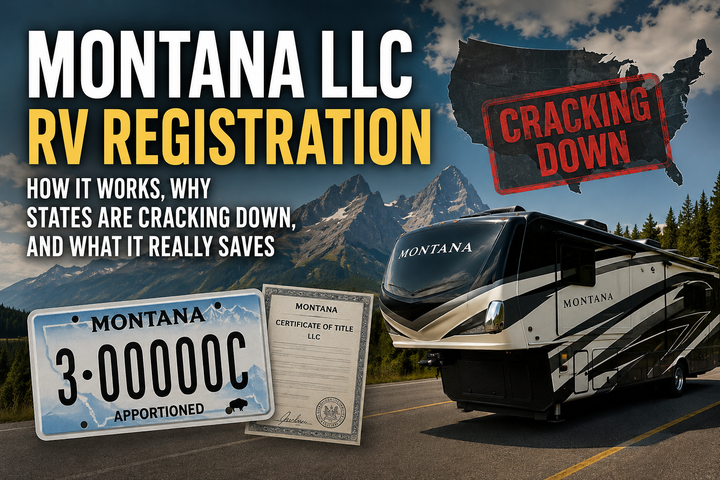
Drive through any large RV resort in Arizona or Florida and count the Montana plates. Statistically, most of those rigs have never seen Big Sky Country. They belong to LLCs — shell companies with no employees, no revenue, and one asset: a motorhome garaged 1,500 miles from the registered agent's office in Helena or Missoula. Montana has 2.68 registered vehicles per licensed driver, the highest ratio in the nation, and that number isn't because Montanans love collecting trucks.
The math behind the scheme is simple and, on paper, spectacular: Montana has no general sales tax, so titling a $200,000 motorhome through a Montana LLC instead of your home state can avoid $14,000–$16,000 in sales tax for a setup cost of roughly $1,000. For decades this was treated as a gray-area cost of doing business by other states. That era is ending. Between 2024 and 2026, California filed criminal charges, Utah passed enforcement legislation, and Illinois courts kept calling these LLCs exactly what they usually are — shams.
This post explains how the arrangement actually works, what it saves on paper, why the risk side of the ledger has grown much faster than the savings side, and who can legitimately register in Montana. To be clear up front: this is general information, not legal or tax advice, and this is an area where you genuinely need a licensed professional before acting.
Why Montana Became the RV Registration Capital of America
Three features of Montana law combine to create the loophole:
- No general sales tax. Montana is one of a handful of states with no statewide sales tax on vehicle purchases. Buy and title a rig there and the sales tax line is zero.
- An LLC counts as a Montana resident. A Montana limited liability company can own and register vehicles in the state even if its members live elsewhere. You don't need to set foot in Montana; a registered agent handles everything by mail.
- Cheap, sometimes permanent registration. Montana motorhome registration runs from about $282.50 a year for a rig under two years old down to $97.50 for one over eight years old — and motorhomes 11 years and older can be permanently registered for a one-time $237.50. Trailers can get permanent plates too. There's an $800 luxury fee for motorhomes with a retail value over $300,000, which is still trivial next to a five-figure tax bill.
How the Setup Works Mechanically
A cottage industry of Montana law firms and registered-agent services has industrialized the process. The steps:
- Form the LLC. The Montana filing fee is $35; service providers charge anywhere from $49 to several hundred dollars to handle it, plus $49–$150 a year for registered agent service. An annual report costs $20.
- Buy the RV in the LLC's name. The dealer sells to "Big Sky Adventures LLC" and ships the paperwork (sometimes, in the aggressive versions, a bill of lading falsely claiming Montana delivery) to the agent.
- Title and register in Montana. The county treasurer issues Montana plates. Total first-year cost, all-in with a service package, typically lands between $1,000 and $2,000 for a motorhome.
- Drive it home. This is where the legal problem starts.
What It Saves on Paper
Take a $200,000 Class A purchased by a buyer living in a state with a 7.5% combined sales tax rate:
| Register at home (7.5% state) | Montana LLC | |
|---|---|---|
| Sales tax | $15,000 | $0 |
| Setup and first-year fees | Standard registration | ≈ $1,000–$2,000 |
| Ongoing annual cost | Registration (value-based in some states) | ≈ $200–$400 (agent, report, plates) |
| Paper savings | — | ≈ $13,000–$14,000 |
| Exposure if caught | None | Back tax + penalties up to 100% + interest, possible insurance denial, possible criminal charges |
The catch is the last row. Nearly every state imposes a use tax — a mirror of sales tax — on vehicles purchased elsewhere but used, stored, or garaged within its borders by a resident. The Montana LLC doesn't erase that obligation; it just hides the vehicle from the systems that would normally collect it. The tax is still legally owed in most fact patterns. That's why enforcement, when it comes, arrives as evasion rather than a mere paperwork dispute.
The Crackdown: 2024–2026
Bloomberg Tax reported in April 2025 that Utah, California, and Illinois are leading a wave of enforcement, and the specifics have escalated since.
California
The CDTFA identified roughly 10,000 vehicles worth nearly $2 billion sold to Montana LLCs since 2022, opened more than 400 investigations touching nearly 500 dealers, and — per state reporting — has recovered $2.3 million in taxes and registration on 601 vehicles since mid-2023. The DMV uses automated license plate readers on state roads to flag Montana-plated vehicles that live in California. In March 2026, the state Attorney General filed a 57-count complaint against 14 people, with charges including conspiracy, filing false sales tax returns, perjury, and money laundering. Investigators cited text messages — one buyer wrote that he didn't "want the state of California to know anything about this car" — and false bills of lading claiming Montana deliveries.
Utah
Governor Cox signed SB 52 in March 2025, letting the Tax Commission cross-match the state's insurance database against registrations to find residents insuring vehicles at Utah addresses while plating them in Montana. Utah estimates roughly 16,000 vehicles and 4,800 boats registered out of state, about $120 million in lost revenue, and its penalty structure allows up to 100% of the tax due, plus interest, on top of the tax itself.
Illinois and others
Illinois law explicitly treats vehicles owned by out-of-state shell entities controlled by Illinois residents as taxable in Illinois, and its tax tribunals have repeatedly ruled against Montana-LLC owners — in one case calling the entity "a sham." Indiana, Missouri, Georgia, and Wyoming have enacted or proposed similar look-through measures.
How people get caught
- License plate readers and toll-transponder data showing a "Montana" rig living at a home-state address
- Insurance records: the policy lists a garaging address in the taxing state
- Data sharing between DMVs, revenue departments, and insurance databases
- Dealer audits — states subpoena sales records for vehicles delivered in-state to Montana LLCs
- Neighbor and whistleblower reports, which several states actively solicit
The Real Risks, Ranked
1. Insurance claim denial — the quiet catastrophe. The tax math gets the headlines, but the insurance exposure is arguably worse. If your policy application states the rig is garaged in Montana (or owned by a Montana company with no real operations) and it actually lives in your driveway in Ohio, you've given your insurer a material misrepresentation. After a $200,000 total loss or a serious liability claim, insurers investigate — and misrepresenting the garaging address is classic grounds for denying the claim or rescinding the policy. The downside isn't $15,000 in tax. It's the entire rig, or an unpaid liability judgment.
2. Back taxes, penalties, and interest. States that catch you assess the original use tax plus penalties — up to 100% of the tax in Utah — plus interest accruing from the purchase date. Total liability can exceed the savings that motivated the scheme, sometimes years later when the vehicle has depreciated and the money is spent.
3. Criminal exposure in aggressive cases. Most enforcement is civil. But California's 2026 complaint shows where the aggressive fact patterns land: false delivery documents, false returns, and concealment can convert a tax shortcut into felony charges.
Who Montana Registration Is Actually Legitimate For
None of this makes Montana plates inherently suspect. They're entirely proper for actual Montana residents, and for businesses genuinely operating there. The nuanced case is full-time RVers. A full-timer with no fixed home who establishes genuine Montana domicile — Montana driver's license, voter registration, mail, tax filings, real ties — can often register there legitimately, because no other state can claim the rig is garaged within its borders. But domicile is a facts-and-circumstances test, not a mailbox subscription. A "full-timer" who spends eight months a year parked beside their kid's house in Sacramento has a California problem no LLC can fix. If you're financing the rig, note that many lenders also restrict or refuse LLC titling — see our guide to RV financing in 2026 for how titling affects loan terms.
Legal Ways to Pay Less Tax on an RV
- Trade-in credit. Most states tax only the difference between the new rig's price and your trade-in's value. Trading a $60,000 fifth wheel against a $150,000 motorhome in a 7% state saves $4,200 in tax — legally and automatically.
- Low-tax and capped states — if you genuinely live there. Oregon, New Hampshire, Delaware, and Alaska have no general sales tax; South Dakota charges a modest 4.2% excise tax. Genuinely relocating or domiciling in a low-tax state is legal; pretending to is not.
- Buy used from a private seller in states that tax private sales lightly — and remember a lower purchase price means proportionally lower tax everywhere. Buying a two-year-old rig sidesteps both the steepest depreciation and thousands in tax versus buying new; our 2026 cost-of-ownership breakdown shows how those numbers compound, and our guide to buying an RV online covers how to shop private-seller listings safely across state lines.
- Timing and structure. Some states cap vehicle tax, offer sales-tax deductions on federal returns for large purchases, or treat RVs used substantially in business differently. These are CPA conversations, not internet-forum conversations.
Questions to Ask a Licensed Attorney or CPA First
- Where will this RV actually be garaged and used more than half the year, and what does that state's use-tax statute say about vehicles owned by out-of-state entities I control?
- Does my state have a look-through or shell-entity rule, and has it pursued Montana LLC cases recently?
- What are the penalty and interest exposure numbers for my specific purchase price if I'm assessed later?
- Will my insurer write a policy that accurately lists my real garaging address and the LLC ownership — in writing?
- If I'm a full-timer, do my facts actually support Montana domicile, and what documentation would I need to defend it?
- Does my lender permit LLC titling, and what does it do to my rate and coverage requirements?
Frequently Asked Questions
Is registering an RV through a Montana LLC illegal?
Forming a Montana LLC and registering a vehicle to it is legal under Montana law. The problem arises in your home state: if the RV is used, stored, or garaged there, that state's use tax and registration laws typically still apply. Skipping them is what states treat as tax evasion — civilly in most cases, criminally in aggressive ones involving false documents.
How much does a Montana LLC RV registration save?
On paper, the full sales tax in your home state: about $15,000 on a $200,000 motorhome in a 7.5% state, against roughly $1,000–$2,000 in LLC formation, registered agent, and Montana registration fees. That's the gross number; it ignores the assessment risk of back taxes, penalties of up to 100% in states like Utah, interest, and insurance complications.
How do states catch Montana LLC RV owners?
Increasingly with data, not luck. California uses license plate readers and has opened 400-plus investigations; Utah's 2025 law cross-matches its insurance database against out-of-state registrations; Illinois audits transactions and applies a shell-entity look-through law. Toll records, insurance garaging addresses, dealer sales records, and neighbor reports round out the toolkit.
What happens if I get caught?
Typically an assessment for the unpaid use tax plus penalties and interest — in Utah, penalties alone can reach 100% of the tax owed. States have recovered six-figure sums from single owners. In aggressive cases involving false delivery paperwork or concealment, criminal charges are possible: California's March 2026 complaint included conspiracy, perjury, and money laundering counts against 14 defendants.
Can full-time RVers legally register in Montana?
Sometimes. A full-timer who genuinely establishes Montana domicile — license, voter registration, tax filings, real ties, and no fixed residence elsewhere — has a defensible basis, because no other state can claim the rig is garaged there. But domicile is a legal test of facts, not paperwork. Full-timers who effectively live in one state most of the year usually owe that state.
Will a Montana LLC affect my RV insurance?
Yes, and this is the most underrated risk. Policies are priced on the garaging address, and LLC ownership must be disclosed. If your application says Montana but the rig lives in your driveway elsewhere, an insurer can deny a major claim or rescind the policy for material misrepresentation — turning a $15,000 tax shortcut into an uninsured $200,000 loss.
This article is for general information only and is not legal, tax, or insurance advice. Laws and enforcement practices change; consult a licensed attorney and CPA in your state before making registration or titling decisions.
The cheapest tax strategy is often just paying less for the rig itself — a lightly used motorhome can cost 25–30% less than new, which shrinks the tax bill by the same proportion with zero legal risk. Browse thousands of new and used RVs on TrueRVs, compare real asking prices across your region, and buy the rig — not the loophole.