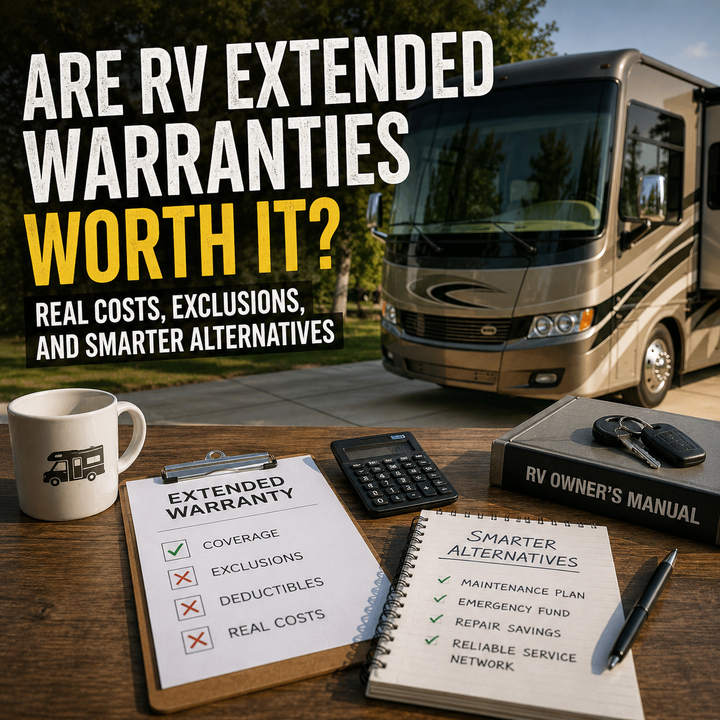
Are RV Extended Warranties Worth It? Real Costs, Exclusions, and Smarter Alternatives
Extended service contracts run $800–$5,000 a year depending on your rig — and dealer quotes often carry 100–300% markup. Here's what these contracts actually cover, the exclusions that surprise owners at claim time, and the honest math on when self-insuring wins.

Somewhere between the sales desk and the finance office, nearly every RV buyer hears the same pitch: one blown air conditioner or slide-out motor will cost you more than this entire contract. Then a number appears on the screen — often $4,000 to $8,000 — and you have about ten minutes to decide while the paperwork is warm.
Here's what that moment hides. The product isn't technically a warranty at all, the price usually carries a dealer markup of 100% or more, and the fine print excludes several of the most common ways RVs actually fail. That doesn't make these contracts a scam — for some owners they genuinely pay off. It means the decision deserves more than ten minutes.
This guide covers what these contracts really cost in 2026, how the two policy structures differ, the exclusions that surprise people at claim time, and the honest math on when you're better off insuring yourself.
What an "Extended Warranty" Actually Is
A true warranty is a promise from the manufacturer, included in the purchase price, that the product will work as advertised. What dealers and third-party companies sell after that expires is an extended service contract (sometimes called a vehicle service contract or mechanical breakdown policy). It's a separate insurance-like product with three parties involved: the seller (dealer or broker), the administrator who processes claims, and the obligor — the company legally on the hook to pay them.
That distinction matters. The dealer who sold you the contract has nothing to do with whether your claim gets paid; the administrator does, so the administrator's reputation is what you should research. And because it's a contract, not a warranty, if something isn't in writing, it isn't covered — no matter what anyone said at the sales desk.
Most contracts carry a per-visit deductible, typically $0 to $500, and repairs must be authorized by the administrator before work begins — which is why "I already paid the shop, now reimburse me" claims so often go badly.
What RV Extended Warranties Cost in 2026
Pricing depends on the RV's type, age, mileage, value, usage (full-time costs more), coverage level, and deductible. Market ranges look like this:
| RV Type & Coverage | Typical Annual Cost | Typical 5–7 Year Total |
|---|---|---|
| Travel trailer / fifth wheel (listed-component) | $800–$1,500 | $2,000–$6,000 |
| Travel trailer / fifth wheel (exclusionary) | $1,200–$2,500 | $4,000–$9,000 |
| Class B / Class C motorhome | $1,500–$3,000 | $5,000–$12,000 |
| Class A gas motorhome | $2,000–$3,500 | $7,000–$15,000 |
| Class A diesel pusher (exclusionary) | $3,000–$5,000+ | $10,000–$20,000 |
Older, higher-mileage rigs cost more to cover, and units past a certain age usually require a paid inspection (often $450 or more) before a company will write a policy. Paying annually instead of monthly frequently earns a 10–20% discount. And avoid rolling the contract into your RV loan — financing $6,000 over 15 years can nearly double its real cost, as our guide to RV financing in 2026 shows.
Exclusionary vs. Inclusionary: The Only Coverage Distinction That Really Matters
Inclusionary (listed-component) policies
These contracts cover only the components explicitly named in the policy. If your specific failure — say, a slide-out gear pack or an inverter transfer switch — isn't on the list, the claim is denied by definition. They're cheaper, and they're the source of most "the warranty didn't cover anything" horror stories. Marketing sometimes labels these "comprehensive," which is backwards — read the structure, not the label.
Exclusionary policies
These flip the logic: everything mechanical is covered except what's listed under "What Is Not Covered." That's the broadest protection available and the structure most experienced RVers recommend if you're buying at all. The exclusion list is short enough to actually read — and that list is the entire contract.
The Exclusions That Surprise People
Even the best exclusionary policy leaves out more than most buyers expect. These are the categories that generate the angriest phone calls:
- Water intrusion and seals. Water damage is the single most expensive thing that happens to RVs, and it is almost universally excluded. Roof membranes, caulking, and seals are considered maintenance items — if a failed seal lets water rot your roof, that's on you. Some companies sell separate seal-and-structure add-ons, but the base contract won't touch it.
- Wear items. Tires, batteries, brake pads, belts, filters, awning fabric — anything that wears out by design is excluded. Some administrators stretch this further, classifying gradual failures of compressors or pumps as "wear and tear" rather than sudden breakdown.
- Pre-existing conditions. Anything wrong with the rig before the policy's effective date is excluded, and the burden of proof effectively falls on you. This is why used-RV policies require inspections and why early claims get extra scrutiny.
- Consequential damage. The sleeper clause. If a non-covered part fails and destroys a covered part, many contracts deny the whole claim. A $30 excluded hose clamp that lets your covered engine overheat can zero out a five-figure repair. Some brokers offer consequential-damage protection as an add-on; if you buy a contract, this rider is usually worth it.
- Maintenance-records requirements. Contracts require you to perform manufacturer-specified maintenance and prove it. No oil-change receipts, no generator service records, no roof inspection log — the administrator can deny a related claim for "lack of maintenance."
- Cosmetics and structure. Windows, upholstery, flooring, cabinetry, paint, and body panels are out — these are mechanical-breakdown contracts.
How Claims Actually Get Denied
The claim process trips up as many people as the exclusions do. The typical flow: your rig breaks, the shop diagnoses the failure, then calls the administrator for authorization before repairing anything. An adjuster reviews the cause of failure against the contract and approves, partially approves, or denies.
The most common denial patterns:
- Cause of failure traced to maintenance or a pre-existing issue. The shop's diagnosis says "corrosion," "gradual deterioration," or "long-term leak," and the adjuster runs with it.
- Consequential damage. The failed part was covered, but the part that caused it to fail wasn't.
- Unauthorized repair. Work began before the administrator signed off. Emergency clauses exist but are narrow.
- Partial payment gaps. The contract caps labor below the shop's rate, excludes diagnostic hours, or pays for a used part when the shop quoted new. You cover the difference.
The defense is boring: keep every maintenance receipt in one folder, photograph your roof and seals annually, read the exclusion list before you sign, and choose an administrator with a long track record and direct-pay relationships with shops.
The Dealer Markup Nobody Mentions at Closing
Service contracts are a star product of the finance office. Industry sources consistently put dealer markup at 100–300% — a contract with a wholesale cost of $1,500–$2,500 routinely sells for $4,000–$6,000 at closing. Three things follow:
The price is negotiable. There's enormous margin to give, and finance managers know it. Treat the first number like a first offer on the RV itself.
You don't have to buy it that day. The urgency is manufactured. As long as your RV meets age and mileage criteria, you can buy a contract weeks, months, or years later — direct from warranty brokers and wholesalers who sell the same administrators' products without the showroom overhead. (Our RV buying checklist covers the other paperwork traps to watch at signing.)
Ask for the administrator and obligor in writing before discussing price. Then compare the dealer's quote against a direct quote for the identical product — and watch the number move.
When a Contract Makes Sense — and When Self-Insuring Wins
The case for buying
A contract earns its keep when the potential repair bills are large relative to your ability to absorb them:
- Diesel pushers and complex motorhomes. A single diesel fuel-system repair can run $8,000; air suspension, hydronic heating, and big slide systems all fail expensively. One well-documented full-timing couple tallied over $23,000 in repairs in two years on an out-of-warranty diesel coach.
- Full-timers. The rig is your house, working every day, and a breakdown means hotel bills on top of repair bills.
- Owners with no repair fund. If a surprise $5,000 bill would land on a 25% credit card, converting that risk into a fixed, known cost is rational even if the expected value is negative — that's what insurance is.
The case for self-insuring
Warranty companies price contracts to pay out less than they take in; that's how they exist. The average owner collects less in claims than they pay in premiums, deductibles, and denied-claim gaps. If you can absorb a bad year, the math favors keeping the money.
Run the numbers honestly: take the quoted premium — say $6,000 for five years on a Class A — put it in a high-yield savings account instead, and add the monthly amount you'd have paid on a payment plan. If the rig behaves, you keep every dollar plus interest. If it doesn't, you pay repairs from the fund with no deductibles, no authorization calls, no excluded consequential damage, and any shop you want. Self-insurance loses only when a catastrophic covered failure hits early, before the fund builds up — precisely the scenario the "case for buying" list describes. A simple travel trailer with no engine or generator rarely justifies a contract; the failure modes aren't expensive enough. Slot this decision into your full budget with our 2026 breakdown of what it really costs to own an RV.
Transferability: The Warranty as a Resale Asset
One underrated feature: most major contracts are transferable to a private-party buyer, usually for a $50–$100 fee. A used RV with two years of exclusionary coverage remaining is meaningfully easier to sell — it answers the biggest fear a used-RV buyer has. Selling? Put the remaining coverage in the first three lines of your listing. Buying used? Confirm the transfer terms with the administrator directly, not the seller. A transferable contract won't add its face value to the price, but it shortens time-to-sale and strengthens your position.
Questions to Ask Before Buying Any Contract
- Is this exclusionary or listed-component coverage? Send the full exclusion list before we talk price.
- Who is the administrator and the obligor, in writing?
- Is consequential damage covered, or available as a rider?
- What maintenance records do you require at claim time?
- What's the labor-rate cap, and are diagnostic hours covered?
- Can I use any licensed shop or mobile tech, and do you pay them directly?
- Is it transferable, and what does cancellation refund (pro-rata, minus what fee)?
- Is there a waiting period before coverage starts?
A seller who dodges these questions has answered them.
Frequently Asked Questions
How much does an RV extended warranty cost?
Expect roughly $800–$2,500 per year for travel trailers and fifth wheels and $1,500–$5,000 per year for motorhomes, depending on age, mileage, coverage level, and deductible. Multi-year totals run from about $2,000 for a short towable plan to $20,000 for top-tier exclusionary coverage on a high-mileage diesel pusher. Dealer quotes at closing often run 100–300% above wholesale pricing.
Do RV extended warranties cover water damage?
Almost never. Roof membranes, caulking, and seals are classified as maintenance items, and water intrusion resulting from their failure is excluded from standard contracts. Some providers sell separate seal-and-structure add-ons. Since water damage is the most expensive common RV problem, the best protection remains inspecting and resealing your roof on schedule — and keeping dated photos as proof.
Can I buy an RV extended warranty after purchase?
Yes. As long as your RV meets the provider's age and mileage criteria, you can buy coverage from third-party brokers and wholesalers months or years after the sale — usually for far less than the finance-office price. Older or used rigs may need a paid inspection first, and most policies carry a short waiting period before coverage begins.
Why do RV warranty claims get denied?
The most common reasons: missing maintenance records, failures attributed to pre-existing conditions or gradual wear, repairs started before the administrator authorized them, and consequential damage — where an excluded part caused a covered part to fail. Labor-rate caps and excluded diagnostic time also shrink payouts. Meticulous service records and pre-authorization prevent most denials.
Is an RV extended warranty negotiable at the dealership?
Very. Contracts with a wholesale cost of $1,500–$2,500 are routinely quoted at $4,000–$6,000 in the finance office. Ask for the administrator's name in writing, get an independent quote for the same product, and counter hard — or simply decline and buy direct later. Never roll the contract into your loan, where interest can nearly double its cost.
Does a transferable warranty increase RV resale value?
It helps, though not dollar-for-dollar. Remaining transferable coverage — usually assignable for a $50–$100 fee — addresses a used-RV buyer's biggest fear and measurably shortens time-to-sale. Feature it prominently in your listing with the expiration date and coverage type. Buyers should verify transfer terms directly with the administrator before treating it as part of the deal.
Whether you end up with an exclusionary contract or a well-fed repair fund, the cheapest insurance is buying the right rig in the first place — one with maintenance records, sound seals, and systems you've actually tested. Browse thousands of new and used RVs from private sellers and dealers at TrueRVs, ask every seller for their service history, and negotiate the warranty on your terms, not the finance office's.