How to Sell an RV in Texas: Title Transfer, Sales Tax & Paperwork (2026)
Everything Texas RV sellers need in 2026: which documents to gather, how title transfer differs for motorhomes vs travel trailers, who pays the 6.25% sales tax, how SPV works, why plates stay with you, and the free VTR-346 form that shields you from the buyer's tickets and tolls.

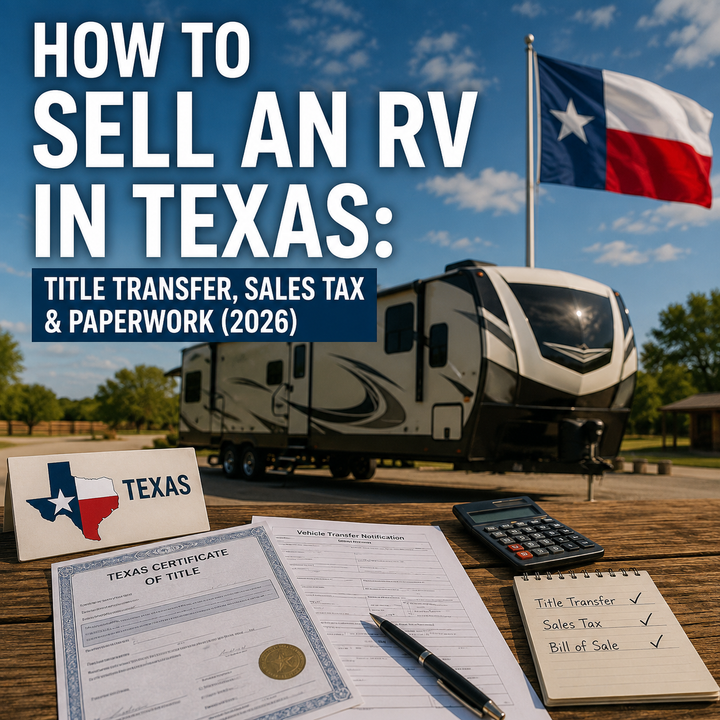
Selling an RV in Texas is refreshingly straightforward once you know which rules apply to your rig. The state treats a Class A motorhome, a fifth wheel, and a small pop-up camper differently in a few important ways — especially around titling and the 4,000-pound trailer threshold — and getting the paperwork right protects you from toll bills, parking tickets, and tax headaches long after the buyer drives away.
This guide walks through exactly what the Texas Department of Motor Vehicles (TxDMV) and the Texas Comptroller require for a private RV sale in 2026: the documents you need in hand before you meet a buyer, how the title transfer works for motorhomes versus travel trailers, who pays the 6.25% motor vehicle sales tax (spoiler: the buyer), what the Standard Presumptive Value rules mean for RVs, and the one free form — the Vehicle Transfer Notification — that every Texas seller should file within 30 days.
If you're still deciding whether to sell privately or trade in, it's worth reading our breakdown of why selling your RV yourself puts thousands more in your pocket first. Once you've decided to sell it yourself, here's how Texas makes it official.
Documents You Need Before You Sell
Gather everything before you list. Nothing kills a deal faster than a motivated buyer standing in your driveway while you hunt for a title you haven't seen since 2019.
| Document | What it is | Who needs it |
|---|---|---|
| Certificate of Title | The Texas title in your name, signed on the back with the date of sale and odometer reading (motorhomes) | Buyer takes it to the county tax office |
| Form 130-U | Application for Texas Title and/or Registration, with the sales price clearly noted | You complete the seller section; buyer files it |
| Form VTR-346 | Vehicle Transfer Notification — tells TxDMV you sold the vehicle | You file it, within 30 days, free |
| Lien release | Proof any loan on the RV has been paid off | Buyer needs it to get a clean title |
| Bill of sale | Written record of price, date, VIN, and both parties | Both of you keep a copy |
| Weight certificate | Scale ticket showing gross weight, if your trailer's paperwork doesn't state it | Needed for some trailer transfers |
Not sure what to ask for the rig itself? Run through our complete 2026 RV valuation guide before you set a price — pricing correctly matters even more in Texas because of how the state calculates sales tax on private sales (more on that below).
How Title Transfer Works: Motorhomes vs. Travel Trailers
Motorhomes (Class A, B, and C)
A motorhome is a motor vehicle, full stop. It must be titled in Texas, and the transfer works like any car or truck sale. You sign the back of the title with the date of sale and the odometer reading, complete the seller portion of Form 130-U with the actual sales price, and hand over any lien release. The buyer then has 30 days from the date of sale to file the title application at a county tax assessor-collector's office, and late transfers can trigger penalties.
TxDMV's best piece of advice for sellers: go with the buyer to the county tax office and watch the title application get filed. It's the surest way to know the RV is out of your name the day the money changes hands.
Travel Trailers and Fifth Wheels: The 4,000-Pound Rule
Texas divides trailers at 4,000 pounds of gross weight — the empty weight of the trailer plus the weight it's rated to carry:
- Gross weight over 4,000 lbs: The trailer must be titled. Virtually every travel trailer, fifth wheel, and toy hauler on the road falls in this category, so the transfer works just like a motorhome sale — signed title, Form 130-U, county tax office.
- Gross weight 4,000 lbs or less: Titling is optional; registration alone is enough. This covers small pop-ups and lightweight teardrop campers. If a lightweight trailer was never titled, a bill of sale plus the registration receipt serves as the evidence of ownership the buyer needs.
Even where a title is optional, TxDMV encourages titling because it's your proof of ownership if the trailer is ever stolen. If your trailer's documents don't state its weight, the buyer may need a certified scale ticket from a public weigh station (a truck stop CAT scale works) to complete the transfer.
Who Pays Sales Tax — and How Texas Calculates It
The buyer pays. Texas charges a 6.25% motor vehicle sales tax on private-party sales, collected from the buyer at the county tax office when they file the title application. As the seller, you owe nothing — but the number you write on Form 130-U matters, so record the real sales price.
Standard Presumptive Value (SPV) and the 80% rule
For private-party sales, Texas doesn't just take the buyer's word on price. The state compares the sales price against the vehicle's Standard Presumptive Value — a market value TxDMV calculates from regional sales data. The rule works like this:
- If the buyer paid 80% or more of SPV, tax is 6.25% of the actual sales price.
- If the buyer paid less than 80% of SPV, tax is calculated on 80% of SPV instead — unless the buyer gets a certified appraisal (from a licensed dealer or insurance adjuster) within 30 days and pays tax on the appraised value.
Does SPV apply to RVs and trailers?
Sometimes. The Comptroller's guidance says SPV procedures may apply to trailers and semitrailers, but SPV values simply aren't available in the state's system for many RVs, trailers, and recreational vehicles. When no SPV exists for the rig, tax is based on the documented sales price — which is exactly why a clear bill of sale and an accurate price on Form 130-U protect your buyer. Note that SPV never applies to travel trailers that qualify for classic vehicle specialty plates, dealer sales, or legitimate gifts to eligible family members (gifts pay a flat $10 gift tax with Form 14-317 instead).
Expect the buyer to also pay a title application fee of $28 or $33, depending on the county.
Write a Bill of Sale (Even Though Texas Doesn't Always Require One)
Texas has no mandatory statewide bill of sale form for most titled vehicle sales, but you should write one anyway — and for never-titled lightweight trailers it's actually part of the ownership evidence. Include: date of sale, sales price, year/make/model, VIN, odometer reading (for motorhomes), names, addresses, and signatures of both parties, and an "as-is" statement. Both parties keep a signed copy. TxDMV also recommends keeping detailed records of the transaction, including the buyer's contact information and the VIN, indefinitely.
License Plates Stay With You
In Texas, plates belong to the seller, not the RV. Before the buyer tows or drives away, remove your plates. You have three options: transfer them to another vehicle of the same classification, keep them for future use (the registration sticker itself doesn't transfer), or deface and dispose of them so no one can use them fraudulently. Leaving your plates on a sold RV is an invitation for someone else's toll charges to land in your mailbox.
Handle the Lien Release Before You List
If you financed the RV, the lender is listed as a lienholder on the title, and no county tax office will issue the buyer a clean title until that lien is released. Ideally, pay off the loan and get the lien release (or a title showing the lien discharged) before listing. If you still owe money, plan the closing at your lender's office or your bank so the payoff, lien release, and buyer's payment happen in one sitting. Be upfront in your listing — serious buyers will ask.
File the Vehicle Transfer Notification (VTR-346) — Your Legal Shield
This is the step Texas sellers skip most often, and it's the one that matters most. Filing a Vehicle Transfer Notification tells TxDMV you no longer own the RV. Do it within 30 days of the sale and, by law, you cannot be held responsible for parking tickets and toll violations the new owner racks up. Skip it, and state records still show you as the owner — meaning tickets, toll bills, and even liability for crimes committed with the vehicle can come back to you.
Filing is free and takes about five minutes online through TxDMV's website, or you can mail Form VTR-346. Do it the same day you sell.
Getting Paid Safely
RV sales involve big numbers, which attracts scammers. A few rules keep you safe:
- Best options: cash counted at your bank, a wire transfer confirmed as received by your bank, or a cashier's check verified by calling the issuing bank directly (not the number printed on the check) — or better, deposited with the buyer present before you sign anything.
- Never release the title or the RV based on a payment "screenshot," a pending Zelle/Venmo transfer, or an overpayment the buyer asks you to refund.
- Close at a bank or the county tax office during business hours. Funds clear, title signs over, everyone leaves with copies.
Where to List Your RV in Texas
Texas is one of the biggest RV markets in the country, and your rig deserves more eyeballs than a windshield sign delivers. A dedicated RV marketplace puts your listing in front of buyers who are actually searching for your exact floor plan — and on TrueRVs, private sellers list free and keep 100% of the sale price, with no commission taken off the top. Selling from out of state or splitting time elsewhere? The process differs meaningfully by state — see our guide to how to sell an RV in Florida for comparison.
Frequently Asked Questions
Who pays sales tax when selling an RV in Texas?
The buyer pays. Texas charges a 6.25% motor vehicle sales tax on private-party RV sales, collected from the buyer at the county tax assessor-collector's office when they apply for title. The seller owes no sales tax. Tax is based on the sales price — or, where a Standard Presumptive Value exists for the vehicle, on at least 80% of that SPV unless a certified appraisal shows a lower value.
Do travel trailers need a title in Texas?
Yes, if the gross weight (trailer weight plus carrying capacity) exceeds 4,000 pounds — which covers nearly all travel trailers and fifth wheels. Trailers with a gross weight of 4,000 pounds or less only need registration, and titling is optional. For a never-titled lightweight trailer, a bill of sale plus the registration receipt documents the transfer of ownership.
What is Form VTR-346 and do I have to file it?
Form VTR-346 is the Texas Vehicle Transfer Notification. It's not mandatory, but filing it within 30 days of the sale means you legally cannot be held responsible for the buyer's parking tickets or toll violations. It's free, takes minutes online at TxDMV.gov, and protects you if the buyer delays retitling. Every Texas seller should file it on the day of sale.
Do license plates stay with the seller in Texas?
Yes. Texas plates belong to the seller, not the vehicle. Remove your plates before the buyer takes possession, then either transfer them to another vehicle of the same classification, keep them for future use, or deface and discard them. The registration sticker does not transfer with the plates. The buyer obtains new registration when titling the RV.
Does Standard Presumptive Value (SPV) apply to RVs?
Sometimes. SPV procedures can apply to trailers and semitrailers, but SPV values are often unavailable in the state's system for motorhomes, travel trailers, and other RVs. When no SPV exists, the buyer's 6.25% tax is based on the documented sales price, so an accurate bill of sale and Form 130-U matter. When SPV does exist, tax is due on the greater of the price or 80% of SPV.
How long does the buyer have to transfer an RV title in Texas?
Thirty days from the date of sale. The buyer files the signed title and Form 130-U at a county tax assessor-collector's office and pays the 6.25% motor vehicle sales tax plus a $28 or $33 title fee, depending on the county. Filing late can trigger penalties. Sellers can protect themselves regardless by filing the free Vehicle Transfer Notification within 30 days.
Ready to find your buyer? List your RV on TrueRVs — it takes a few minutes, there's no commission, and you keep 100% of your sale price while thousands of Texas buyers browse for their next rig.
Disclaimer: DMV and tax rules change. This article is general information, not legal or tax advice — confirm current requirements with TxDMV, the Texas Comptroller, or your county tax assessor-collector before completing a sale.