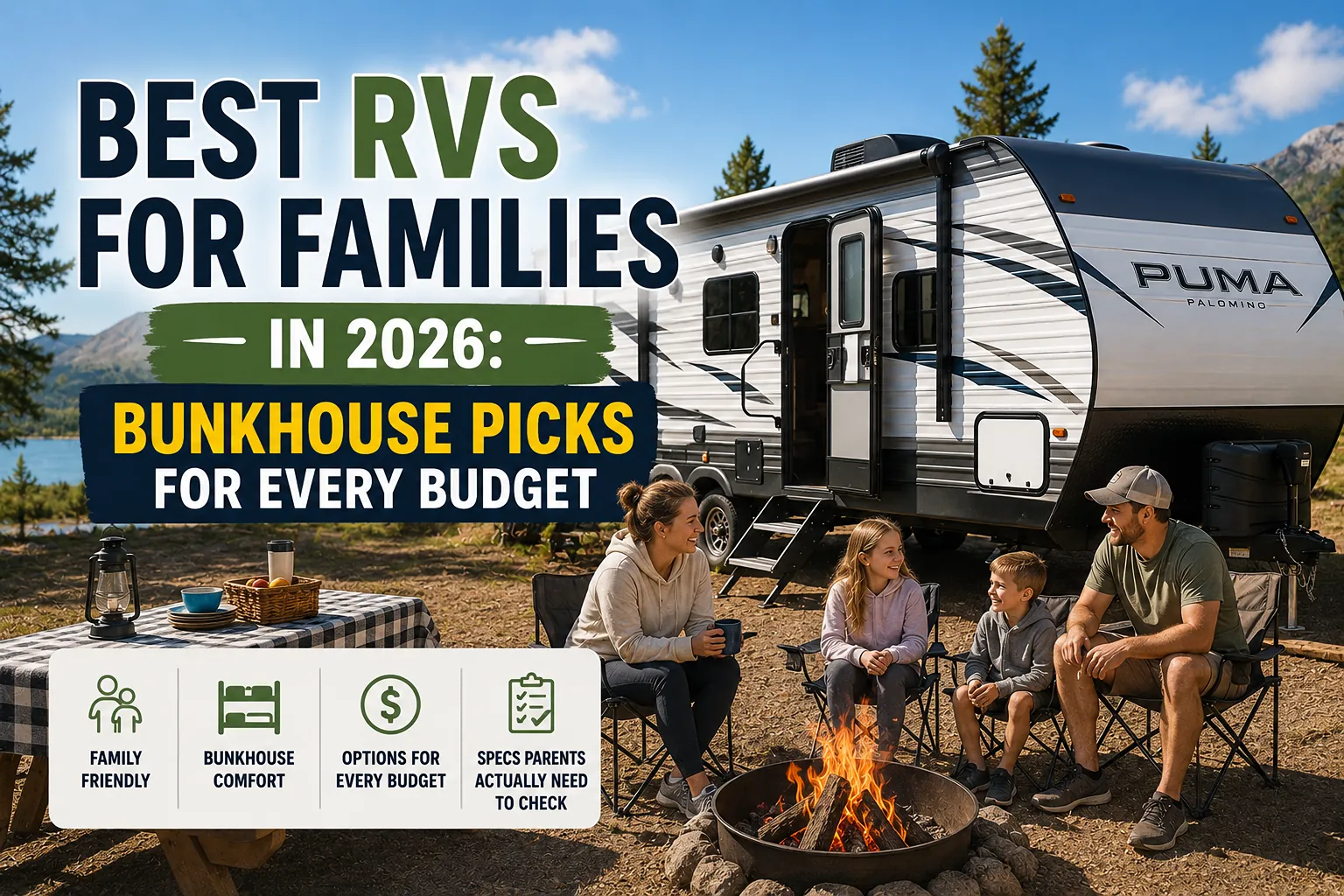
Best RVs for Families in 2026: Bunkhouse Picks for Every Budget (and the Specs Parents Actually Need to Check)
TrueRVs Team 7 min read
Family RV shopping has a trap built into it: the number on the brochure that says "Sleeps 8."
That number counts every convertible dinette, fold-down sofa, and bunk in the rig. What it doesn't tell you is whether there are eight seatbelts for the drive (in a motorhome), whether the bunks can hold your growing kids (bunk weight ratings vary from 200 to 600 pounds), or whether anyone can reach the bathroom while the slide is in at a rest stop. Those are the specs that decide whether your family actually enjoys the RV — and they're the ones this guide checks for you.
Below: the best family RVs of 2026, organized by budget and type, followed by the checklist we'd use before buying any of them.
(Traveling as a pair instead? See our best RVs for couples. Planning to live aboard? Start with the best RVs for full-time living.)
Quick Picks by Situation Situation Our Pick Type Approx. Price First family RV, tightest budget Jayco Jay Flight SLX 170BH Travel trailer ~$18,000 Best budget bunkhouse Heartland Prowler 2600BH Travel trailer ~$26,000 Best all-around family trailer Grand Design Imagine 2910BH Travel trailer ~$45,000 Big family, big truck Keystone Cougar 28BHS Fifth wheel ~$55,000 Family road-trippers (drivable) Winnebago Minnie Winnie / Thor Four Winds bunk models Class C $110,000–$140,000 Maximum space, drivable Forest River Georgetown 34H5 Class A ~$150,000 Best Budget Family Trailers (Under $30,000) Jayco Jay Flight SLX 170BH — ~$18,000
The classic starter bunkhouse. Front bed for the parents, rear bunks for the kids, a real (if compact) bathroom, and Jayco's two-year warranty. At around 3,000 pounds dry, it's towable by many mid-size SUVs — which for a lot of families means no new truck, and that's a five-figure savings hiding in the spec sheet. Bunks are rated at 300 lbs (single) and 600 lbs (double), so it won't age out when the kids hit middle school.
Heartland Prowler 2600BH — ~$26,000
Nearly 30 feet of trailer for the price of a compact car: front private bedroom, rear double bunks, and a layout that gives parents and kids actual separation — the feature families discover they needed about two rainy days into their first trip. You'll want a half-ton truck to tow it.
Best Mid-Range Family Trailers ($35,000–$60,000) Grand Design Imagine 2910BH — ~$45,000
There's a reason the Imagine is everywhere — we wrote a whole review of the 2026 Grand Design Imagine explaining why. The 2910BH is the family floorplan of the lineup: double-over-double bunks, a queen bedroom up front, an outdoor kitchen for campground dinners, and Grand Design's build quality and customer service reputation, which is the real reason owners stay loyal. If your budget reaches the mid-$40Ks, this is the default answer.
Jayco Jay Flight 264BH — ~$38,000
The full-size version of the starter trailer above: bigger tanks, bigger galley, a slide-out that opens up the living space, and the same family-proof bunk ratings. The Jay Flight is the best-selling travel trailer in America, which also means strong resale and easy service anywhere in the country.
Best Family Fifth Wheel Keystone Cougar 28BHS — ~$55,000
When you have three or more kids — or two kids and a dog and a grandparent — trailers start running out of room, and fifth wheels take over. The Cougar 28BHS gives kids a genuine rear bunk room (not a bunk corner), parents a front bedroom a full staircase away, and the kind of storage that swallows bikes and camp chairs. You need a proper truck with a fifth-wheel hitch, but no towable gives a family more livable space per dollar.
Best Drivable Family RVs
If your family trips are measured in states rather than campgrounds, a motorhome changes the experience: kids ride in the living space (belted — see the checklist below), the bathroom is aboard, and setup at camp takes minutes. Our Class A vs Class B vs Class C guide covers the trade-offs in depth; for families it usually comes down to these two:
Class C bunk models: Winnebago Minnie Winnie 31K / Thor Four Winds 28A — $110,000–$140,000
The Class C bunkhouse is the family road-trip machine: cab-over bed for one kid (the most fought-over sleeping spot in RVing), bunks for the others, and a chassis that drives like a big truck rather than a bus. Winnebago's Minnie Winnie earns its price premium in build quality and resale; Thor's Four Winds undercuts it and is everywhere on the used market, which makes it the value play.
Class A bunk models: Forest River Georgetown 34H5 — ~$150,000
The Georgetown 34H5 is what happens when a family outgrows everything else: a bunk room for the kids, king bedroom for the parents, bath-and-a-half so nobody's waiting in line, and Class A storage bays underneath it all. It's the most house-like family rig you can buy without crossing into diesel-pusher money.
The Family RV Checklist (What "Sleeps 8" Doesn't Tell You)
Before you fall for any floorplan, check these six things:
Seatbelts, not sleeping spots. In a motorhome, count the actual belted positions — everyone rides belted, every trip. A rig that sleeps eight but belts five is a five-person rig. (In a towable, this is simple: nobody rides in the trailer, ever. The family rides in the tow vehicle.)
Bunk weight ratings. Bunks range from roughly 200 to 600 pounds of rated capacity. Kids grow; a 200-lb bunk becomes a storage shelf faster than you think. Look for 300+ on singles and check the sticker, not the salesperson.
Real payload math. A family of five packs 800–1,200 pounds of gear, water, food, and bikes. Subtract the RV's dry weight from its GVWR — if the difference (cargo capacity) is under 1,500 lbs on a family trailer, you'll be leaving things home.
The rainy-day test. Slides in, everyone inside: can people get to the bathroom, sit somewhere, and not be touching each other? Two-space layouts (bunk room + living area) keep the peace on the third wet day.
Tank capacity per person. Boondocking or state parks without hookups? Divide the fresh tank by the number of people. Under 10 gallons per person means every trip is a hookup trip.
Your actual tow vehicle. The number one mistake RV buyers make is buying a trailer their vehicle can't safely pull. Keep loaded trailer weight under 80% of your tow rating, and remember the family and gear in the truck count against payload too.
And budget honestly: the purchase price is the beginning, not the total. Our breakdown of what it really costs to own an RV puts real numbers on insurance, storage, maintenance, and fuel — read it before you set your ceiling.
Frequently Asked Questions
What's the best RV for a family of 4? A bunkhouse travel trailer is the sweet spot: the Jayco Jay Flight SLX 170BH on a budget, or the Grand Design Imagine 2910BH if you can reach the mid-$40Ks. Two bunks, a parents' bed, and a tow vehicle you may already own.
What's the best RV for a family of 6 or more? Look for double-over-double bunks (Imagine 2910BH) or a dedicated bunk room (Keystone Cougar 28BHS fifth wheel, Georgetown 34H5 Class A). Check the belted seating count if it's a motorhome — six sleepers need six belts for the drive.
Can kids ride in a travel trailer while it's being towed? No. Regardless of what any state technically allows, no one should ride in a towed trailer — there are no belts, no airbags, and no crash protection. The family rides in the tow vehicle; if the tow vehicle can't seat everyone, the trailer is the wrong RV.
Is a motorhome or travel trailer better for families? Trailers win on price, and you get a normal vehicle to explore with once you've set up camp. Motorhomes win on road-trip comfort — onboard bathroom, belted seating in the living area, faster setup. Families who camp in one place for a week usually prefer trailers; families who cover miles prefer motorhomes.
Should we buy new or used for our first family RV? For a first RV, strongly consider used. Families are the most likely buyers to discover their needs changed after a season — kids' ages, camping style, tow vehicle. A 2–3 year old rig costs 25–30% less, and if you resell in two years, you lose far less. Once you know exactly what your family needs, buy that rig new.
When should we buy to get the best price? Fall and winter for the lowest prices; spring for the widest selection. If you're buying used from a private seller, late fall is when motivated sellers price to move.
Find Your Family's RV
Every rig in this guide — and thousands of other family-ready RVs, new and used — is listed on TrueRVs. Browse RVs for sale, filter by type and price, and compare real listings from dealers and private sellers side by side.