RV Title Transfer: Every Document You Need to Sell an RV (2026 Checklist)
TrueRVs Team 7 min read
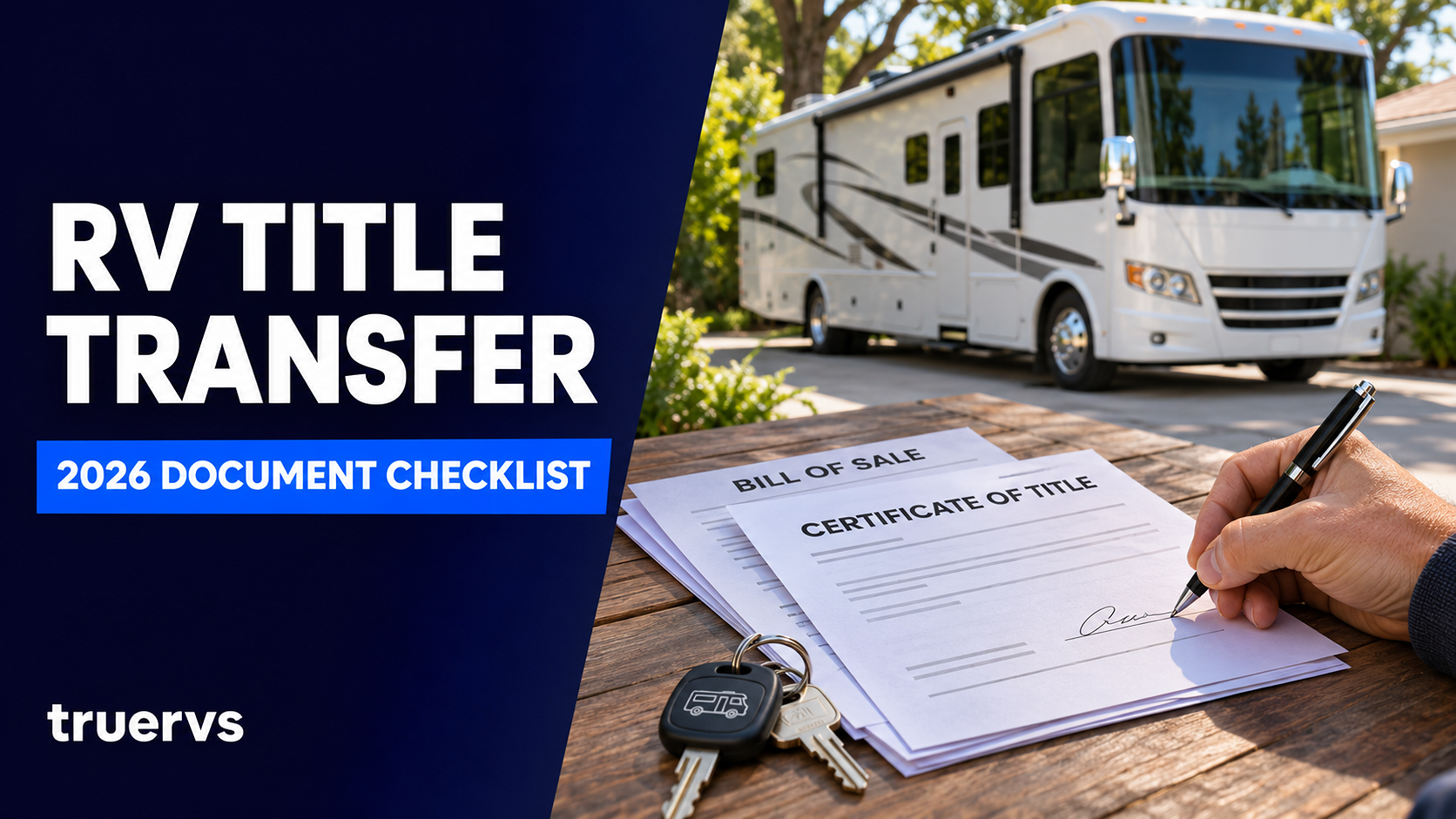
Table of contents
- The RV Sale Paperwork Checklist
- 1. The Certificate of Title
- 2. The Bill of Sale
- 3. Lien Release (If the RV Was Ever Financed)
- 4. Odometer Disclosure for Motorhomes
- 5. Notarization: Which States Require It?
- 6. Release of Liability or Notice of Sale
- What If the Title Is Lost or Damaged?
- Selling an RV Out of State
- What About an Inherited RV?
- Make the Rest of the Sale Just as Smooth
- Frequently Asked Questions
RV Title Transfer: Every Document You Need to Sell an RV (2026 Checklist)
To sell an RV you need the title in your name, a bill of sale, a lien release if the RV was ever financed, and an odometer disclosure for most motorhomes. After the sale you file a notice of sale or release of liability with your state so you are not responsible for what the new owner does. Some states also require the title signatures to be notarized. Get these right and the transfer takes about fifteen minutes.
Ready to sell? Sell my RV on TrueRVs: list in about five minutes, pay once, and keep 100% of the sale.
Paperwork mistakes are the most common reason a private RV sale stalls at the finish line. A misspelled name, a signature in the wrong box, or a forgotten lien release can send a buyer to the DMV three times. Here is everything you need, in order.
The RV Sale Paperwork Checklist
| Document | Required? | Who Provides It | Notes |
|---|---|---|---|
| Certificate of title | Always | Seller | Must be in seller's name, signed correctly |
| Bill of sale | Required in many states, recommended everywhere | Both parties sign | Include VIN, price, date, as is language |
| Lien release | If the RV was financed | Seller's lender | Some states print it on the title |
| Odometer disclosure | Most motorhomes | Seller | Often part of the title; towables have no odometer |
| Notarization | Some states | Notary | AZ, KY, LA, MT, NC, OH, OK, PA and others |
| Release of liability or notice of sale | Most states | Seller files | File within your state's deadline |
| Maintenance records and manuals | Optional | Seller | Builds buyer trust and helps your price |
| Warranty transfer forms | If applicable | Seller and warranty company | Some extended warranties transfer for a fee |
1. The Certificate of Title
The title is the document that actually transfers ownership. Before you list, confirm three things:
- Your name is on it exactly as it appears on your ID. If you married, divorced, or inherited the RV and the name does not match, fix that with your DMV before the sale.
- There are no open liens. If a bank is listed as lienholder, you need a lien release or the lender has to sign off.
- The VIN matches the RV. Check it against the VIN plate or sticker, usually near the entry door, on the frame, or on the dash of a motorhome.
How to sign the title correctly: sign in the seller section only, exactly as your name is printed. If two owners are listed with "and," both must sign. If they are listed with "or," usually either can sign. Do not use white out or cross anything out. A damaged title often has to be replaced before the buyer can register the RV.
2. The Bill of Sale
A bill of sale is your receipt and your protection. Even in states that do not require one, every RV seller should use one. It should include:
- Seller and buyer full names and addresses
- RV year, make, model, and VIN
- Sale date and sale price
- Odometer reading for motorhomes
- A statement that the RV is sold "as is, where is, with no warranties expressed or implied"
- Signatures of both buyer and seller
Many states publish their own bill of sale form on the DMV website. Using your state's form makes registration smoother for the buyer.
Sample bill of sale language:
I, [Seller Name], of [Address], sell to [Buyer Name], of [Address], the following recreational vehicle: [Year] [Make] [Model], VIN [number], odometer [miles], for the sum of $[amount], received in full on [date]. The RV is sold as is, where is, with no warranties expressed or implied. Seller certifies they are the legal owner and the RV is free of all liens and encumbrances.
Seller signature / date. Buyer signature / date.
3. Lien Release (If the RV Was Ever Financed)
If you financed the RV, the lender holds the title or is listed on it until the loan is paid off. You have three common ways to handle it:
- Pay off the loan before the sale. The lender mails the title or a lien release, and you sell with a clean title.
- Close at your lender. The buyer's funds go straight to the lender, the lender releases the lien, and any equity comes back to you.
- Use the lender's payoff process. The buyer pays the lender the payoff amount directly and pays you the difference.
Ask your lender for a payoff letter good for at least 10 days before you list. Our guide on how to sell an RV with a loan on it walks through each option step by step.
Even if you paid your RV off years ago, check the title. If an old lender is still printed on it and you never received a release, contact them now. Lost lien releases are a common cause of delays.
4. Odometer Disclosure for Motorhomes
Motorized RVs generally require an odometer disclosure at sale, recorded on the title or on a separate federal odometer statement. Towable RVs like travel trailers and fifth wheels have no engine and no odometer, so they skip this step. Heavier motorhomes over 16,000 pounds GVWR are exempt from federal odometer disclosure, but many states still ask for the reading, so record it on the bill of sale either way.
5. Notarization: Which States Require It?
Some states require the seller's signature on the title, and sometimes the buyer's, to be notarized. These include Arizona, Kentucky, Louisiana, Montana, North Carolina, Ohio, Oklahoma, and Pennsylvania, and several others require a notarized bill of sale. Rules change, so check your state DMV site before the sale.
If your state requires a notary, plan to meet the buyer at a bank, a UPS store, or a tag agency where a notary is on site. Many banks notarize for free for their own customers.
6. Release of Liability or Notice of Sale
This is the step sellers forget most, and the one that protects you after the RV leaves. Filing a release of liability tells your state you no longer own the RV. Without it, parking tickets, toll violations, abandoned vehicle fees, and even accident claims can come back to you.
Deadlines are short. California, for example, requires sellers to file a Notice of Transfer and Release of Liability within 5 calendar days of the sale, and it can be done online. Most states have a similar form, often called a notice of sale or transfer notification.
Also:
- Remove your license plates if your state keeps plates with the owner.
- Cancel your registration if your state allows a refund.
- Cancel your insurance, but only after the buyer has taken possession.
What If the Title Is Lost or Damaged?
You cannot sell an RV without a valid title. Apply for a duplicate title from the state where the RV is titled. Most states process it in one to six weeks, and many offer expedited service for a fee. Start this before you list, not after you have a buyer.
Selling an RV Out of State
When the buyer lives in another state, you still follow your own state's rules for signing the title and filing the release of liability. The buyer handles registration and sales tax in their home state. Many buyers will need a temporary transit permit or trip permit to drive or tow the RV home, which they get from their state or from yours.
What About an Inherited RV?
If you inherited an RV, you typically need the death certificate and either letters testamentary from the estate or your state's affidavit for small estates, depending on the value and your state's rules. The DMV will issue a title in your name or allow you to sign as the estate's representative. Sort this out before you list.
Make the Rest of the Sale Just as Smooth
Clean paperwork makes buyers trust you, and trust is what gets your asking price. Pair it with a well priced listing in front of the right buyers. On TrueRVs, Seller Shield screens incoming messages and blocks most scam inquiries before they reach you, and on the higher-tier packages the AI Shopper matches your RV with buyers searching for your exact type and budget. For the whole process start to finish, see how to sell an RV privately.
Frequently Asked Questions
Does an RV title need to be notarized? Only in some states, including Arizona, Kentucky, Louisiana, Montana, North Carolina, Ohio, Oklahoma, and Pennsylvania. Check your state DMV before the sale.
Do I need a bill of sale to sell my RV? Some states require it and every seller should use one. It is your proof of the price, date, and as is condition.
Who registers the RV after the sale? The buyer. They take the signed title and bill of sale to their DMV, pay sales tax and fees, and register it in their name.
What happens if I do not file a release of liability? You can be held responsible for tickets, tolls, and fees tied to the RV until the buyer registers it. File it within your state's deadline.
Can I sell an RV without a title? No. Apply for a duplicate title from your state before you list.
Paperwork ready? List your RV on TrueRVs and get it in front of buyers who are ready to sign.
More from TrueRVs: RVs for sale · Sell my RV · AI Shopper