Where to Sell Your RV in 2026: RV Trader vs RVT.com vs TrueRVs (Honest Comparison)
Samuel Atallah 8 min read
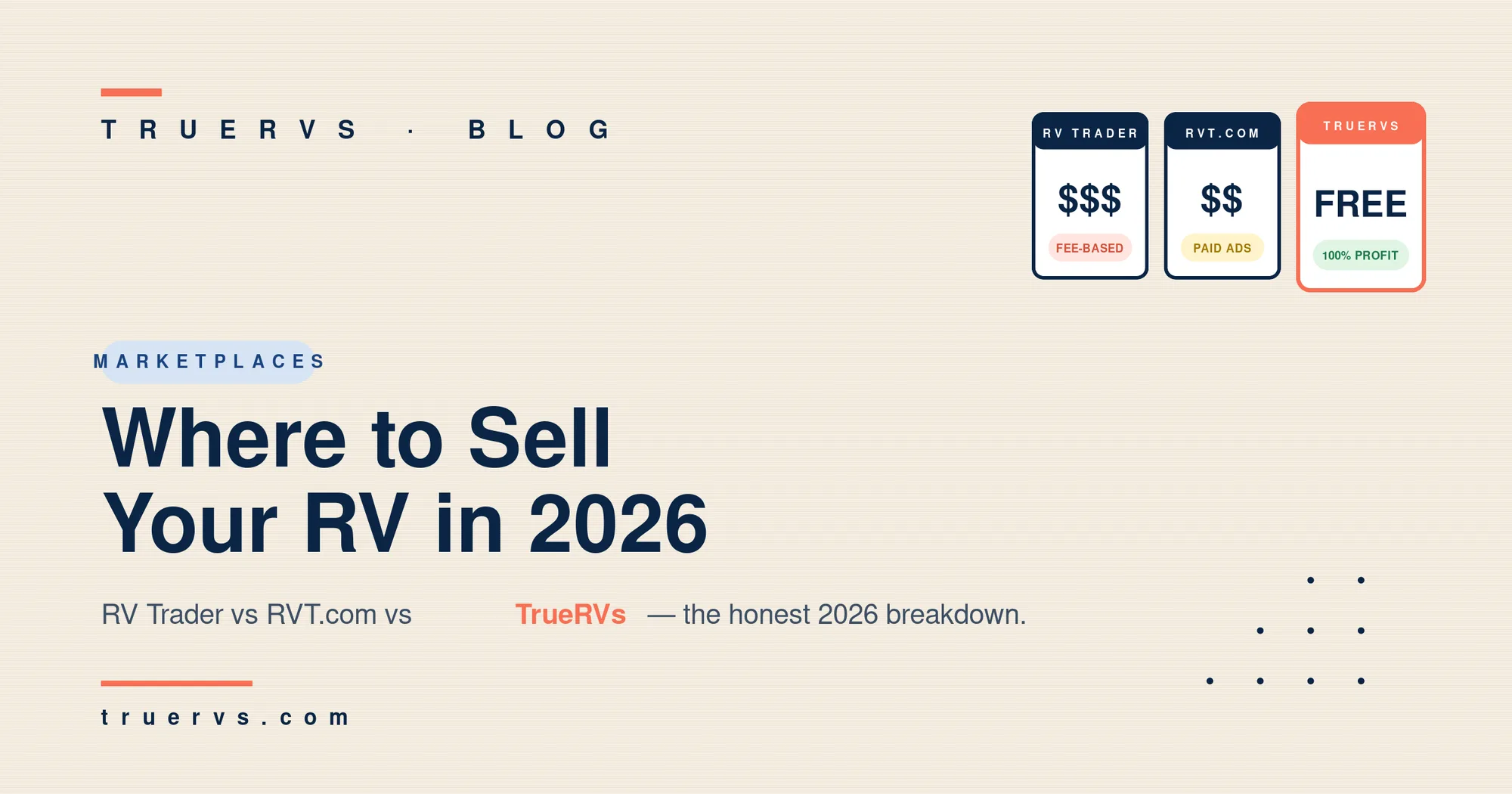
Table of contents
If you're selling an RV in 2026, three marketplaces dominate the conversation: RV Trader, RVT.com, and TrueRVs. Each promises the same thing — qualified buyers, fast sales, top dollar — but the experience, the fees, and the money you actually walk away with are very different.
This guide is a head-to-head, no-fluff comparison of all three. We pulled current pricing from each platform, cross-referenced Trustpilot reviews and public seller forums, and laid out exactly which marketplace makes sense for which kind of seller.
By the end, you'll know which platform is actually the best fit for your RV — and which ones might quietly cost you thousands.
Quick answer: which marketplace is best for sellers?
If your only goal is to put the most money in your pocket with the least friction, the answer in 2026 is TrueRVs, because it's the only one of the three that charges nothing to list and takes no commission on the sale.
If you want maximum buyer reach and don't mind paying for it, RV Trader still has the largest audience in the category. If you want a middle-ground option that's been around for two decades and tends to cost less than RV Trader, RVT.com is a solid choice with a strong Trustpilot score.
But none of that matters until you understand what each platform actually charges and what you actually get for it. Here's the breakdown.
What each marketplace actually is
Before comparing pricing, it helps to understand what kind of platform each of these really is, because they're not as similar as the homepages suggest.
RV Trader
RV Trader is the largest dedicated RV marketplace in North America by listing volume, owned by Trader Interactive (the same parent company behind Cycle Trader and Commercial Truck Trader). It's primarily a paid-listing model: you pay a flat fee for a certain number of days, a certain number of photos, and a certain level of visibility in search results.
Most of RV Trader's inventory comes from dealers. Private sellers can list too, but pay a separate fee structure designed for one-off sales.
RVT.com
RVT.com has been around since 1999 and serves a slightly smaller but loyal audience. It's built on the same paid-listing model as RV Trader — listing fees by tier, no commission on sale — but its pricing tends to come in lower than RV Trader at every tier.
RVT also offers a money-back guarantee on its top-tier "Ultimate Ad" package: if your RV doesn't sell within a certain window, you can get your listing fee refunded (subject to terms).
TrueRVs
TrueRVs is the newest of the three, launched in 2026. It's built on a different business model entirely: listings are free, both for private sellers and dealers, and the platform doesn't take a commission when your RV sells. You keep 100% of the sale price.
TrueRVs makes money through dealer subscriptions and advertising rather than seller fees, which means private sellers can list nationwide reach without paying anything upfront or on closing.
Fees and pricing: the honest breakdown
This is where the differences get real. Here's what each platform actually charges a private seller in 2026, based on currently published pricing.
RV Trader offers three private-seller packages. The entry-level package starts around $80 and goes up to roughly $350for the most aggressive package with premium placement, more photos, and longer ad duration. There's no commission on the sale, but if your RV doesn't sell, you don't get the listing fee back.
RVT.com offers five packages, starting at around $30 for the basic listing and going up to $240 for the top "Ultimate" tier with extended duration and featured placement. The Ultimate package includes a money-back guarantee if your RV doesn't sell within the listing period (terms apply). RVT.com is consistently the cheaper of the two paid marketplaces.
TrueRVs charges $0 to list, regardless of RV value, photos, or listing duration. There's no commission when your RV sells. The seller keeps the entire sale price.
Trustpilot and reputation: what other sellers actually say
Public seller reviews tell a clearer story than marketing pages. Here's where each platform actually lands.
RV Trader currently sits at roughly 3.0 out of 5 stars on Trustpilot across more than 150 reviews. Common complaints cluster around message delivery issues (some sellers report that only a fraction of buyer inquiries actually reach them), low-quality image rendering, and difficulty getting refunds when ads underperform. The volume and consistency of these complaints is worth taking seriously before paying for the higher tiers.
RVT.com holds a much stronger 4.8 out of 5 stars on Trustpilot across more than 5,000 reviews — one of the highest seller ratings in the entire RV marketplace category. Negative reviews tend to focus on scam attempts from buyers (a problem on every marketplace) and occasional delays in email delivery.
TrueRVs is too new to have an established Trustpilot rating yet — the platform launched in early 2026. Early seller feedback is positive, but anyone considering TrueRVs should weigh that lack of long-term reputation data alongside the zero-fee model.
Seller experience: what actually happens after you list
What it actually feels like to sell on each platform is different in ways the pricing tables don't capture.
On RV Trader, you'll get the largest volume of inquiries — but also the highest volume of low-quality leads. Many sellers report that the cost-per-actual-buyer is higher than it looks, because a non-trivial percentage of inquiries are tire-kickers or scam attempts. Communication happens through RV Trader's messaging system, which has been a source of complaints around delivery reliability.
On RVT.com, the audience is smaller but tends to skew more serious. Sellers commonly report fewer total inquiries but a higher proportion of qualified buyers. The lower price point also means the math works out better even if your RV sits for a few weeks before selling.
On TrueRVs, the seller experience is closer to a modern e-commerce flow. Listings can be created in minutes, the dashboard shows real-time view and inquiry data, and the platform includes AI shopper tools that help match buyers to your listing. Because there's no listing fee, there's no pressure to "renew" or upgrade — you can leave a listing live as long as you need to.
Pros and cons of each platform
RV Trader
Pros
- Largest dealer and private-party inventory in the U.S.
- Strong brand recognition among RV shoppers
- Aggressive featured-placement options for maximum visibility
- No commission on sale (you keep the full sale price minus the listing fee)
Cons
- Most expensive of the three (up to $350+ for top-tier private seller packages)
- 3.0 Trustpilot rating with consistent complaints about message delivery
- No refund if your RV doesn't sell
- High volume of low-quality / scam inquiries
RVT.com
Pros
- Lower pricing than RV Trader at every tier
- 4.8 Trustpilot rating across 5,000+ reviews
- Money-back guarantee on top-tier Ultimate package
- Long-established platform (since 1999)
Cons
- Smaller buyer audience than RV Trader
- Some sellers report fewer inquiries overall
- Add-on costs for priority placement and extra features
- Still requires paid listing — no free tier
TrueRVs
Pros
- Free to list for private sellers — no listing fee, no commission
- No upgrade pressure or "renew to keep your listing active" model
- Modern, e-commerce-style seller dashboard with real-time analytics
- AI shopper matching to surface your listing to relevant buyers
- Sellers keep 100% of the sale price
Cons
- New platform (launched 2026) — no long-term Trustpilot reputation yet
- Smaller current inventory than RV Trader or RVT.com
- Best for sellers willing to be early adopters of a newer marketplace
Who should use which platform
Choose RV Trader if: You want maximum buyer reach, you're willing to pay $80–$350 for it, and you're comfortable filtering through a higher volume of low-quality inquiries to find the right buyer.
Choose RVT.com if: You want a proven platform with a strong seller reputation, you're price-sensitive, and you'd rather pay $30–$240 once and let your listing run.
Choose TrueRVs if: You don't want to pay anything to list, you want to keep 100% of the sale price, and you're open to a newer platform that's still scaling its buyer audience.
There's also no rule that says you can only pick one. Many sellers list on TrueRVs first (since it's free) and add a paid RVT.com or RV Trader listing only if they want extra reach after the first few weeks.
The verdict
For most private sellers in 2026, the math is simple: start with TrueRVs, because there's no downside to a free listing. If your RV doesn't get enough traction after 30–60 days, layer on RVT.com as the lower-cost paid option, and only add RV Trader if you want maximum aggressive reach.
The era of paying $200+ just to list a private RV is ending. The platforms charging that today are still useful, but they're competing against a free alternative that's growing fast. Use the right combination for your timeline and budget, and you'll walk away with thousands more than the seller who defaults to the most expensive option out of habit.
Frequently asked questions
Is it free to list an RV on TrueRVs? Yes. TrueRVs charges no listing fee and takes no commission on the sale. Private sellers keep 100% of the sale price.
How much does it cost to list on RV Trader? RV Trader's private-seller packages currently range from roughly $80 for the basic package to about $350 for top-tier listings with premium placement and extended duration.
Is RVT.com cheaper than RV Trader? Yes. RVT.com's packages currently range from roughly $30 to $240, generally cheaper than RV Trader at comparable tiers.
Which RV marketplace has the best Trustpilot rating? RVT.com leads with a 4.8 out of 5 rating across 5,000+ reviews. RV Trader sits at about 3.0. TrueRVs launched in 2026 and doesn't yet have a Trustpilot rating.
Should I list on more than one platform at once? Many sellers do. Listing on TrueRVs (free) first, then adding RVT.com or RV Trader for extra reach if needed, is a common strategy that minimizes upfront cost while maximizing buyer exposure.
Do any RV marketplaces refund your fee if the RV doesn't sell? RVT.com offers a money-back guarantee on its top-tier "Ultimate" package, subject to terms. RV Trader does not refund listing fees. TrueRVs has nothing to refund because it's free.
Ready to list? Create your free listing on TrueRVs in under five minutes — no fees, no commissions, full nationwide reach.