
What RV Can My Truck Tow? A Complete 2026 Guide to Towing Capacity, Trailer Weight, and Choosing the Right RV

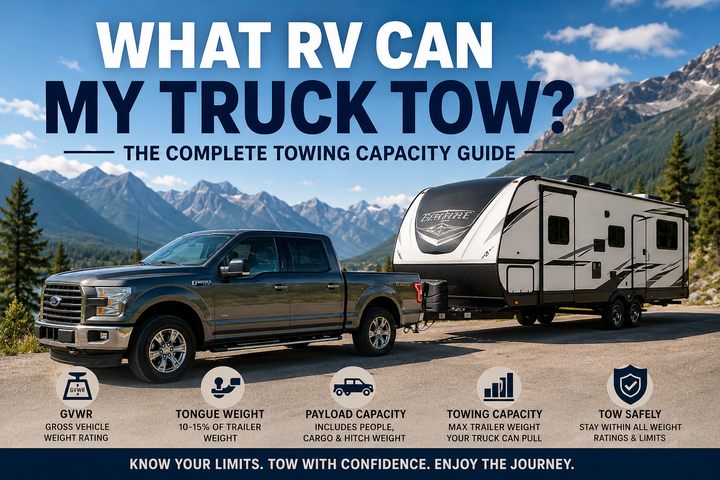
One of the most common questions people ask before buying an RV is simple:
It’s one of the most important questions too.
Choosing the wrong RV for your truck can turn what should be an exciting purchase into a stressful and expensive mistake. Every year, thousands of buyers end up with trailers that are too heavy, poorly balanced, or simply unsafe for their vehicle. And most of the time, it happens because they relied on the wrong number.
Many buyers look at the advertised “max tow rating” of their truck and assume that’s the only number that matters. In reality, towing an RV safely is much more complicated than that.
Your payload capacity, hitch weight, loaded trailer weight, passengers, and cargo all play a role in determining what you can actually tow.
That’s why understanding towing before you shop is so important.
Whether you drive a Ford F-150, Ram 1500, Chevrolet Silverado 2500HD, or Ford F-350 Super Duty, this guide will help you understand how to match your truck to the right RV.
And when you’re ready to compare towable RVs, TrueRVs makes it easier to browse by type, weight, and budget so you can shop smarter.
Why Towing Capacity Matters More Than Most Buyers Realize
Towing an RV isn’t just about whether your truck can move it.
It’s about whether it can stop it, control it, and safely handle it in real-world conditions.
A trailer that’s too heavy can put serious strain on your transmission, suspension, brakes, and tires. It can make highway driving unstable, increase stopping distances, and create dangerous sway in windy conditions or during sudden lane changes.
This becomes even more important when you’re driving through mountain passes, steep grades, or long-distance routes where heat and stress build quickly.
A truck operating at its limits all the time will wear down faster.
And more importantly, it puts your safety at risk.
That’s why experienced RV owners almost never tow right at max capacity. Most aim to stay below it to create a safer buffer.
If you’re buying your first RV, understanding this now can save you from making a costly mistake later.
The Biggest Mistake RV Buyers Make: Confusing Dry Weight With Real Weight
One of the biggest traps in the RV world is dry weight.
Dry weight is the weight of the RV before it’s loaded with anything.
No water.
No propane.
No food.
No clothes.
No batteries.
No camping gear.
No personal belongings.
The problem is, nobody travels at dry weight.
A trailer with a dry weight of 6,500 pounds can easily weigh 7,800 to 8,500 pounds once it’s fully loaded.
This is why buyers often think they’re safe when they aren’t.
The number you need to pay attention to is GVWR, which stands for Gross Vehicle Weight Rating.
This tells you the maximum weight the RV can legally and safely weigh when fully loaded.
If you’re shopping on TrueRVs, always compare the RV’s GVWR against your truck’s actual towing capacity—not just the dry weight.
That gives you a much more realistic picture.
Understanding Payload: The Most Overlooked Number in RV Towing
If there’s one number that surprises first-time buyers the most, it’s payload.
Payload is how much weight your truck can carry.
This includes everything:
Passengers.
Dogs.
Coolers.
Tools.
Cargo.
And most importantly—tongue weight.
This is where many half-ton trucks run into trouble.
A truck might advertise 12,000 pounds of towing capacity, but only have 1,700 pounds of payload.
If your trailer puts 1,100 pounds on the hitch and you have four passengers plus luggage, you may already be over payload.
That’s a huge problem.
Payload is often the real limiting factor—not towing capacity.
Always check your door sticker.
That’s the most accurate number.
What Can a Half-Ton Truck Tow?
Half-ton trucks are the most common trucks used for RV towing.
Vehicles like the Ford F-150, Chevrolet Silverado 1500, Ram 1500, and Toyota Tundra are capable of towing many travel trailers safely.
For most properly equipped half-ton trucks, the sweet spot is usually between 5,000 and 8,000 pounds loaded.
That opens the door to many popular trailers like the Grand Design Imagine and Keystone Cougar.
These are ideal for couples, small families, and first-time buyers who want good space without moving into heavy-duty truck territory.
Half-ton trucks can tow a lot—but staying conservative usually makes the experience far better.
Better gas mileage.
Better control.
Less stress.
Better long-term reliability.
What Can a 3/4-Ton Truck Tow?
Once you move into a 3/4-ton truck like a Ford F-250 Super Duty or Ram 2500, your options expand dramatically.
This is where fifth wheels become much more realistic.
A 3/4-ton truck can often safely tow anywhere from 10,000 to 15,000 pounds depending on setup.
That opens the door to larger travel trailers, toy haulers, and mid-size fifth wheels like the Grand Design Reflection.
For many serious RV buyers, this is the ideal middle ground.
You get stronger towing capability without jumping all the way into a one-ton truck.
If you plan on longer trips or heavier camping, this is often the best category.
What Can a One-Ton Truck Tow?
This is where towing opens up almost everything.
Trucks like the Ford F-350 Super Duty, Ram 3500, and Chevrolet Silverado 3500HD are designed for serious towing.
These trucks are ideal for large luxury fifth wheels, toy haulers, and full-time RV setups.
If you’re planning to live in your RV full-time, this is often the safest and most comfortable route.
A bigger truck means more margin.
And in towing, margin equals peace of mind.
Travel Trailer vs Fifth Wheel: Which Is Easier to Tow?
This is another common question.
Travel trailers are easier to get into because they’re less expensive and work with more trucks.
But they can sway more.
They require more careful weight distribution.
And they can feel less stable at higher speeds.
Fifth wheels tow differently.
Because the hitch sits over the rear axle, the weight distribution is much better. That creates a more stable towing experience and better turning.
For long-term RVers, fifth wheels are often preferred.
But they require bigger trucks.
It all depends on your goals.
How to Shop for the Right RV Based on Your Truck
The smartest RV buyers shop backward.
Instead of finding an RV first and hoping it works, they start with their truck’s real capabilities.
That means:
Understanding your tow rating.
Understanding your payload.
Understanding your hitch limits.
Understanding your real-world cargo weight.
Once you know those numbers, you can shop confidently.
That’s where TrueRVs helps simplify the process.
Instead of browsing outdated marketplaces with limited filtering, TrueRVs lets buyers compare travel trailers and fifth wheels faster, search dealer inventory nationwide, and connect directly with sellers.
You can even use the AI Shopper to narrow down RV options based on your truck, budget, and lifestyle.
That saves time—and helps you avoid buying the wrong RV.
Final Thoughts
The question isn’t just “Can my truck tow this?”
The real question is:
Can it tow it safely, comfortably, and consistently?
That’s the difference.
Understanding towing capacity before you buy an RV can save you money, improve your safety, and make your entire RV ownership experience better.
Whether you’re towing your first travel trailer or upgrading into a full-time fifth wheel, making the right match matters.
And if you’re ready to start comparing towable RVs, browse the latest travel trailers and fifth wheels on TrueRVs and find the right fit for your truck.