
Van Life in 2026: Why the Movement Exploded and Why It’s Still Growing

Over the past decade, van life has transformed from a niche subculture into one of the most searched and discussed lifestyle movements in America. What began as a minimalist travel experiment has evolved into a mainstream housing alternative, a remote work solution, and a cultural symbol of mobility and independence.
In 2026, van life is no longer just a hashtag. It is an economic force within the RV industry, a design influence on major manufacturers, and a search trend that continues to grow year after year.
To understand why van life became so popular, you have to look at more than aesthetics. You have to look at economics, technology, psychology, and shifting definitions of success.
The Economic Catalyst Behind Van Life
One of the primary drivers behind the van life explosion was financial pressure. Rising housing costs, student loan debt, and the increasing price of urban living pushed many people to reconsider traditional home ownership.
For a growing segment of Americans, the idea of paying rent in a major city while working remotely began to feel outdated. When remote work became normalized, location independence suddenly became practical rather than aspirational.
A camper van offered something powerful: mobility without sacrificing shelter.
Instead of a mortgage or high monthly rent, van dwellers could redirect funds toward travel, savings, or flexible living. While van life is not necessarily “cheap” when done properly, it offered a form of financial control that traditional housing often does not.
This economic shift coincided with a larger cultural move toward experiences over possessions.
Social Media Amplified the Movement
If economics sparked van life, social media poured gasoline on it.
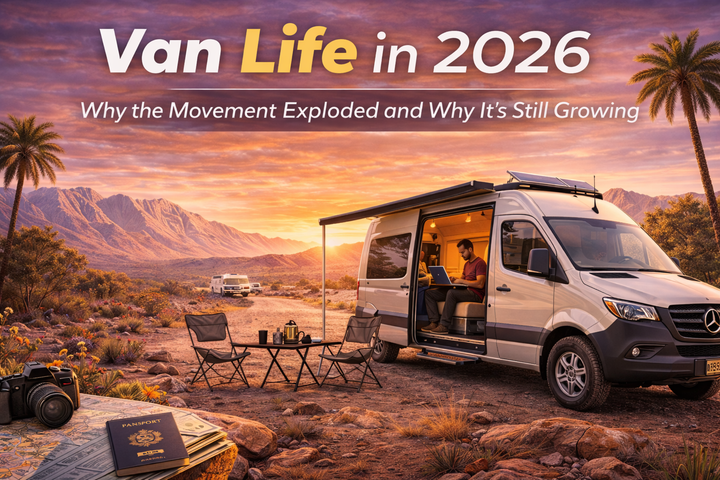
Platforms like YouTube, Instagram, and later TikTok created a constant stream of beautifully edited van conversions parked beside deserts, mountains, and coastlines. The aesthetic was compelling: small but well-designed interiors, golden-hour sunsets, portable workstations overlooking scenic landscapes.
But beyond aesthetics, social media normalized the idea that life could be structured differently.
The visual storytelling around van life reframed it from “living in a vehicle” to “living with intention.” That shift in framing mattered.
Search volume for terms like “van life build,” “camper van conversion,” and “how to live in a van” increased steadily. As more people consumed the content, curiosity turned into participation.
Manufacturers took notice.
The Rise of Factory-Built Class B Vans
While early van lifers often converted cargo vans themselves, demand eventually pushed major manufacturers to respond. Brands like Winnebago, Airstream, and Storyteller Overland began producing factory-built Class B vans designed specifically for lifestyle travelers.
These units included:
- Solar power systems
- Lithium battery storage
- Convertible beds
- Compact kitchens
- Wet baths
- Swivel captain’s chairs
- Off-grid capabilities
The availability of professional-grade van builds removed a major barrier to entry. Not everyone has the skills or time to complete a full DIY conversion. Factory-built vans made van life more accessible to professionals, retirees, and families.
As inventory expanded, so did marketplace search volume. Buyers began comparing models nationwide, researching battery specs, tank capacities, and off-road performance before making purchasing decisions.
Van life transitioned from trend to industry segment.
Remote Work Made It Sustainable
Perhaps the most powerful accelerant for van life was the normalization of remote work.
Before widespread remote employment, van life often required seasonal work, freelancing, or savings. But once professionals could work from anywhere with reliable internet, the model became sustainable long-term.
The van became both home and office.
Portable Wi-Fi systems, solar upgrades, and battery improvements made it possible to run laptops, cameras, and communication tools without constant campground hookups. The ability to work in the morning and explore in the afternoon redefined work-life balance for many.
This alignment between income stability and mobility transformed van life from temporary adventure into legitimate lifestyle choice.
Minimalism and Intentional Living
Another key reason van life gained popularity is psychological rather than economic.
Modern life is crowded. Digital notifications, consumer pressure, and social comparison fatigue have pushed many individuals toward minimalism.
Living in a van forces prioritization.
Space is limited. Storage is strategic. Possessions must justify their presence. For some, this constraint creates clarity. It reduces decision fatigue and increases intentionality.
The van becomes not just a vehicle, but a filter.
In an age of abundance, intentional limitation can feel freeing.
Adventure Culture and National Parks
The United States offers extraordinary public land access compared to many countries. National parks, Bureau of Land Management (BLM) land, and dispersed camping options make mobile living feasible.
The van life movement intersected perfectly with increased interest in outdoor recreation. Hiking, climbing, mountain biking, and overlanding all benefit from a mobile basecamp.
A camper van allows adventurers to wake up at trailheads, change locations easily, and avoid hotel dependency.
That flexibility continues to attract buyers in 2026.
Is Van Life Still Growing?
Search trends suggest yes.
Interest in:
- Class B vans for sale
- Camper van conversions
- Off-grid RV
- Best van for full-time living
remains strong.
However, the tone has matured.
Early van life content focused heavily on aesthetics. Today’s buyers ask more practical questions:
- What is the resale value?
- How long do lithium batteries last?
- What are insurance costs?
- Is it sustainable long-term?
The market has shifted from aspirational curiosity to informed evaluation.
Where Van Life Fits in the Modern RV Marketplace
Van life is now a core component of the RV industry. Class B vans consistently rank among the most searched RV categories nationwide.
Buyers researching van life often explore multiple platforms, including RV Trader and Facebook Marketplace. However, search behavior frequently expands beyond local markets as buyers compare similar builds across states.
Modern RV-focused marketplaces like Truervs aim to support structured van searches by allowing buyers to filter by length, features, and price — reducing clutter and improving match accuracy.
As van life inventory grows, filtering precision becomes increasingly important.
The Reality of Van Life
While van life offers freedom, it is not without challenges.
Space limitations require discipline.
Maintenance is ongoing.
Weather conditions matter.
Parking regulations vary by city.
Community can be transient.
Yet for many, the tradeoff remains worthwhile.
Van life is less about escaping responsibility and more about redefining it.
Why Van Life Is Likely Here to Stay
The movement aligns with multiple long-term trends:
- Remote work normalization
- Rising housing costs
- Outdoor recreation growth
- Desire for mobility
- Digital entrepreneurship
- Minimalist lifestyle philosophy
These are not temporary shifts.
They are structural.
As long as mobility, flexibility, and autonomy remain valued, van life will maintain its place within the broader RV ecosystem.
Final Thoughts
Van life became popular because it intersected with economics, technology, culture, and psychology at the same time. It offered an alternative narrative to traditional living — one built around movement rather than permanence.
In 2026, van life is no longer fringe. It is integrated into the RV marketplace, supported by major manufacturers, and sustained by digital search behavior.
What began as a subculture is now a segment.
And as long as people continue searching for freedom on their own terms, van life will remain one of the most influential forces shaping the future of RV travel.