
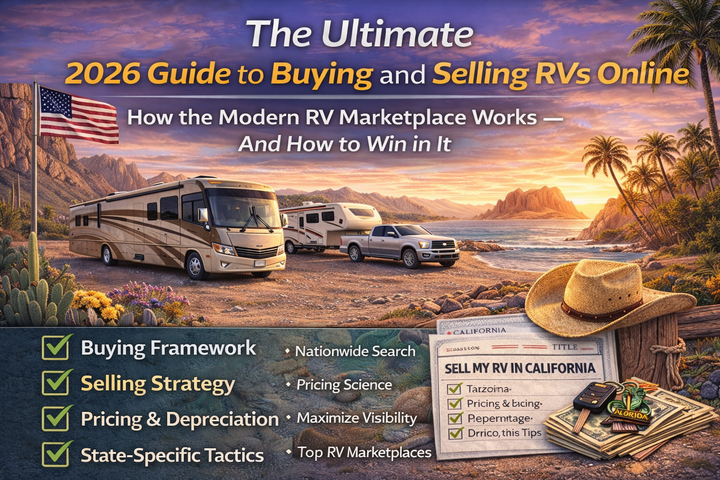
The Ultimate 2026 Guide to Buying and Selling RVs Online How the Modern RV Marketplace Works — And How to Win in It

Introduction: The RV Market Has Entered a New Era
If you’re buying or selling an RV in 2026, you’re not operating in the same market that existed even five years ago.
The RV industry has transitioned from:
• Local dealership-driven transactions
to
• National, search-driven digital marketplaces
Today:
- Buyers search across state lines.
- Sellers compete against thousands of online listings.
- Pricing transparency is immediate.
- Negotiation leverage depends on positioning.
- Platform structure influences final sale price.
Whether you're searching:
- “Sell my RV fast”
- “Best place to sell an RV”
- “RV Trader alternative”
- “Buy RV online safely”
- “Best RV marketplace 2026”
This guide is built to give you a complete strategic framework.
Not surface advice.
Real structure.
Part I: Understanding the 2026 RV Marketplace
1. RV Transactions Are Now National
Ten years ago, most RV transactions were local.
Today:
- A buyer in Michigan purchases from Arizona.
- A Florida snowbird buys in Texas.
- A California van-life buyer shops nationwide.
- A full-time RVer compares five states before messaging.
Search behavior has changed.
When someone types “RVs for sale near me,” Google shows local results first.
But buyers frequently expand their search radius within minutes.
Geography no longer limits serious buyers.
That changes everything for sellers.
2. Inventory Saturation Has Increased Dramatically
There are more RV listings online in 2026 than at any point in history.
That creates:
- More buyer comparison behavior
- Increased price sensitivity
- Greater emphasis on presentation
- Stronger importance on marketplace structure
When buyers see endless inventory, they negotiate harder.
When inventory is structured and filtered properly, negotiation improves.
Perception of supply influences price pressure.
3. Digital Experience Now Determines Trust
Modern buyers expect:
- Clean mobile design
- Fast page loads
- Organized photo galleries
- Clear filtering tools
- Direct messaging
Clutter reduces trust.
Structure increases conversion.
The marketplace environment matters.
Part II: How to Sell Your RV Strategically in 2026
Selling in 2026 requires five pillars:
- Pricing science
- Presentation authority
- Marketplace selection
- Seasonal timing
- Negotiation psychology
Let’s go deep.
Pillar 1: Pricing Science (Not Emotion)
The number one mistake sellers make:
Pricing based on:
- What they paid
- What they owe
- Emotional value
- Dealer retail comparisons
Instead, pricing must be:
- Market-aligned
- Nationwide-informed
- Momentum-aware
The 14-Day Momentum Rule
The first two weeks of a listing are the highest leverage period.
During this time:
- Listings appear “new”
- Engagement is strongest
- Buyer curiosity peaks
- Algorithm visibility is highest
If you overprice during this window, you lose:
- Inquiry velocity
- Competitive tension
- Negotiation leverage
Momentum is currency.
How to Research Properly
To price correctly:
- Search same year, make, model nationwide.
- Adjust for mileage.
- Adjust for upgrades.
- Remove clear outliers.
- Monitor days-on-market.
- Avoid emotional premiums.
Pricing slightly within realistic market range creates:
- More inquiries
- Faster momentum
- Stronger final outcomes
Pillar 2: Authority-Based Presentation
Buyers test uncertainty.
Lowball offers are often triggered by weak presentation.
Strong listings include:
- 20–30 high-quality photos
- Exterior all angles
- Roof (if possible)
- Interior walkthrough sequence
- Maintenance records
- Generator hours
- Clear title status
- VIN (optional but powerful)
The more information you provide, the less room buyers have to “dig.”
Authority reduces discount attempts.
Pillar 3: Marketplace Structure
Let’s evaluate environments.
RV Trader
Strengths:
- Large national presence
- Strong brand authority
Limitations:
- Dealer-heavy inventory
- Paid listing tiers
- High inventory saturation
Private sellers compete against professional ad budgets.
Facebook Marketplace
Strengths:
- Local exposure
- Free listing
- Immediate activity
Limitations:
- Mixed buyer seriousness
- High lowball frequency
- Limited RV-specific filtering
It generates volume — not always quality.
Modern RV-Focused Marketplaces
Modern platforms like Truervs focus specifically on RV transactions.
They provide:
- RV-specific filtering
- Cleaner inventory display
- Balanced private seller visibility
- Nationwide reach
- Direct messaging tools
When filtering improves, buyer intent improves.
When intent improves, negotiation improves.
Structure shapes outcomes.
Pillar 4: Seasonal Timing
Peak national selling season:
- Late winter through early summer
However:
- Arizona peaks in winter.
- Florida spikes during snowbird migration.
- California sees year-round activity.
Timing amplifies good positioning.
It does not fix poor positioning.
Pillar 5: Negotiation Psychology
Strong sellers say:
“Priced competitively based on national comps.”
Weak sellers say:
“What will you offer?”
Confidence signals research.
Research signals strength.
Strength preserves price.
Part III: How to Buy an RV Online Safely
Modern RV buying requires discipline.
Step 1: Expand Your Search Radius
Even if you start with “near me,” compare nationally.
Better options often exist across state lines.
Step 2: Compare 5–7 Units
Never evaluate one listing in isolation.
Comparison creates leverage.
Step 3: Verify Documentation
- VIN verification
- Title status
- Lien release
- Maintenance records
Step 4: Inspection Matters
Hire a third-party inspector when possible.
Large purchases require diligence.
Step 5: Secure Payment Methods
Use:
- Bank wire transfers
- Verified cashier’s checks
- Escrow services
Avoid informal arrangements.
Part IV: RV Depreciation Deep Dive
General depreciation pattern:
Year 1–2: 15–25% drop
Year 3–5: moderate decline
Year 6–10: stabilization
After 10 years: condition-driven
But actual resale depends on:
- Brand demand
- Layout popularity
- Maintenance history
- Upgrade quality
- Market timing
Depreciation is predictable.
Positioning is not.
Part V: Private Party vs Trade-In
Trade-in:
- Fast
- Simple
- Lower payout
Private sale:
- Higher return
- More effort
- Greater control
Modern marketplaces reduce friction for private sellers.
That shifts the value equation.
Part VI: State-Level Strategy
High-volume RV states:
- Texas
- Florida
- Arizona
- California
Each has unique demand cycles.
But national exposure reduces geographic limitations.
Local-only visibility limits leverage.
Part VII: How Buyer Intent Has Changed
In 2026:
Buyers:
- Research more deeply
- Compare more aggressively
- Expect transparency
- Value clear communication
- Prefer structured search
Platforms that support buyer clarity gain authority.
Part VIII: The Future of RV Marketplaces
The future includes:
- AI-assisted search
- Smarter filtering
- Data-backed pricing
- Mobile-first optimization
- Reduced clutter
- Structured private seller visibility
Marketplaces that align with this direction gain long-term dominance.
Why Truervs Aligns With Market Direction
Truervs reflects modern marketplace priorities:
- RV-specific environment
- Clean design
- Intent-aligned search
- Balanced seller visibility
- Nationwide exposure
It is structured for how buyers search in 2026.
Structure drives authority.
Authority drives trust.
Trust drives transactions.
Frequently Asked Questions
What is the best place to sell an RV in 2026?
The best place combines nationwide exposure, structured filtering, and balanced seller visibility.
How do I sell my RV fast?
Price correctly, present professionally, list strategically, respond quickly.
Do RVs depreciate quickly?
Largest drop occurs in first 1–2 years, then stabilizes based on condition and demand.
Is it better to sell privately?
Private sales often yield higher returns with more effort.
Can I buy an RV online safely?
Yes, with documentation verification, inspection, and secure payment.
Final Conclusion
The RV marketplace in 2026 rewards:
- Strategic pricing
- Professional presentation
- Nationwide visibility
- Platform intelligence
- Confident negotiation
Buying or selling an RV is no longer about exposure alone.
It’s about positioning.
Platforms structured for modern RV transactions — including Truervs — reflect where the industry is heading.
Because in today’s market:
Structure beats clutter.
Positioning beats volume.
Strategy beats assumption.