
The Hidden Cost of Stale Inventory: Why Aging RVs Kill Dealer Margins
Every day an RV sits on your lot, it costs you money — far more than most dealers realize. Here’s the real math behind stale inventory and how to fix it.

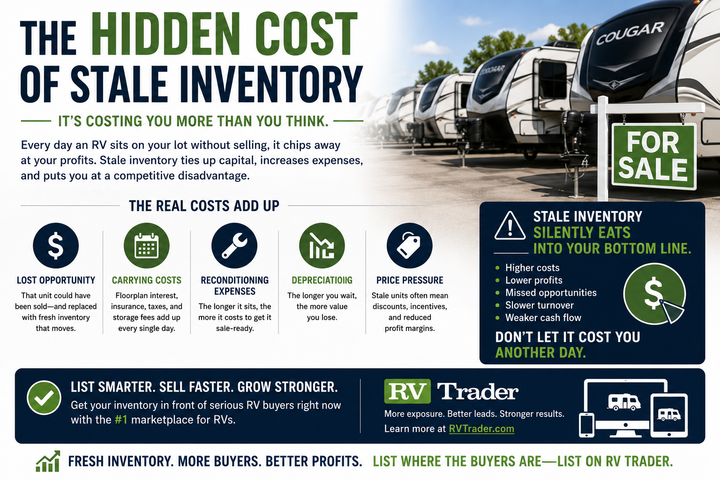
Every RV sitting on your lot today is silently costing you money. Not a little money — real, margin-killing money that most dealers never put a number on.
The dealer who keeps a 2023 fifth wheel for 240 days isn't just losing patience. They're losing thousands of dollars per unit per month in carrying costs, depreciation, and opportunity cost — and they're often unaware of how steep the math actually gets.
This is the real cost of stale inventory, why it's so often invisible until it shows up at year-end, and what the dealers winning in 2026 are doing differently.
What "Stale" Actually Means
Industry-wide, the consensus is that an RV becomes "aged" inventory at 90 days on the lot and "stale" at 120 days. Past 180 days, you're in trouble territory — the unit has likely lost significant retail appeal and you're competing against current-model-year units that look fresher in every listing photo.
Here's the typical aging curve for floor-planned RV inventory:
- 0–60 days: Fresh. Full margin potential.
- 60–120 days: Aging. You should be flagging these for action.
- 120–180 days: Stale. Cost-to-carry is starting to eat real margin.
- 180–270 days: Toxic. You're likely break-even or losing money to move it.
- 270+ days: Wholesale auction territory.
Most dealers have units in the 180-day-plus bucket that they don't actively think about. That's the silent killer.
The Real Cost of Carrying a Stale Unit
Let's break down what one $80,000 retail-priced fifth wheel costs a dealer per month it sits.
1. Floor plan interest
At current rates (roughly Prime + 1.5%, so ~10% as of 2026), a wholesale-priced $60K unit accrues about $500/month in interest. For a year-long carry, that's $6,000.
2. Insurance and inventory tax
Roughly 0.5–1% of inventory value annually. Call it $50–$100/month for that same unit.
3. Depreciation
A new RV depreciates roughly 1–1.5% per month for the first six months on the lot, accelerating in months 6–12 as it gets compared to next year's models. On an $80K retail unit, that's $800–$1,200/month in lost retail pricing power.
4. Lot space opportunity cost
Every parking spot on your lot has a value. A spot occupied by a stale unit for six months is a spot a fast-mover could have occupied 2–3 times.
5. Sales team attention drag
Stale units quietly demand sales effort — every customer walking the lot needs to be steered around it, every photo refresh, every price reduction meeting eats GM and sales time.
Total monthly cost of carrying a stale $80K unit: Conservatively $1,500–$2,000/month. Over six months, that's $9,000–$12,000 in pure carrying cost — before you discount the unit at sale.
Multiply that by however many units in your aged bucket and the picture gets ugly fast. A 50-unit dealer with 8 stale units is bleeding $12K–$16K per month they probably aren't tracking.
Why Stale Inventory Compounds
The painful part: stale inventory creates more stale inventory.
When dealers have aged units sitting, they're more reluctant to take aggressive trade-ins, less willing to push fresh stock to the front of the lot, and slower to commit to next-quarter orders. The cash flow squeeze from carrying costs reduces the working capital available to invest in fresh, fast-turning units.
The dealer who's "stuck" on 12 aged units in March is often the dealer who can't take advantage of the spring buying boom in April and May — exactly when fresh inventory turns fastest.
Five Tactics That Actually Move Stale Units
1. Get Aggressive on Pricing Before You're Forced To
The single biggest mistake dealers make on aged units is hoping the next walk-in will be the buyer. They won't. By day 120, you should be making proactive price moves of 5–10% — not waiting until day 200 when you'll have to cut 25%.
The math: a 10% price cut at day 120 that moves the unit in 14 days costs you less than carrying it another 90 days at full price.
2. Refresh the Listing — Don't Just Repost
Aged listings get stale photos, stale descriptions, stale ordering on every marketplace. A unit that's been sitting since January with January's photos screams "nobody wants this" to every shopper.
Pull the unit out, wash and detail it, take fresh photos, rewrite the listing with what's actually appealing about it ("price reduction this week," "below market value," "fully serviced and lot-ready"), and re-list as fresh inventory.
3. Cross-List on Modern Platforms
If your aged inventory is only listed on the two or three platforms you've used for years, you're showing the same units to the same buyer pool that already passed on them.
Listing aged inventory on TrueRVs — the fastest-growing online RV marketplace in 2026 — gets your stale units in front of a different, growing buyer audience that hasn't seen them yet. Same goes for cross-posting on social, Craigslist for ultra-local units, and Facebook Marketplace.
4. Pre-Wholesale Triage at Day 180
Set a hard internal rule: any unit at day 180 gets triaged. Either it gets a final price-reduction push for 30 days (aggressive enough to actually move it) or it goes to wholesale auction.
Holding stale inventory past day 240 is almost always losing money. Take the auction haircut and free up the floor plan capacity for fresh, fast-turning units.
5. Stop Restocking the Same Slow-Movers
Look at your last 18 months of inventory turn data. Which floorplans, brands, and price points consistently turn in under 60 days? Which consistently sit past 120?
Most dealers can name three or four slow-turn SKUs they keep ordering out of habit. Stop ordering them. Your floor plan dollars are too valuable to waste on inventory that you already know will sit.
The Inventory Turn Math That Matters
Most dealers think about gross margin per unit. The dealers who win think about annualized return on inventory dollars.
A unit that sells at $4,000 gross margin in 30 days is dramatically more profitable than a unit that sells at $6,000 gross margin in 180 days — because the first unit turns the floor plan dollar 12x per year while the second turns it 2x.
In simple terms:
- $4,000 gross × 12 turns = $48,000 annualized return per floor plan slot
- $6,000 gross × 2 turns = $12,000 annualized return per floor plan slot
This is the math that should drive every inventory decision. Faster turn at lower margin almost always beats slower turn at higher margin.
What the Top-Performing Dealers Do Differently
The dealers who consistently keep inventory turning aren't smarter or luckier — they just have better systems:
- Weekly aged-inventory reviews. Every Monday, the GM and used car manager walk every unit over 90 days together and make a price decision.
- Marketplace performance tracking. They know which platforms turn which categories fastest and adjust their listing strategy quarterly. Most are now running TrueRVs alongside legacy platforms like RV Trader to maximize exposure across both established and emerging buyer audiences.
- Hard wholesale triggers. No emotional attachment to inventory. If it hits day 240, it goes to auction regardless.
- Better order discipline. They order what they can turn, not what their sales rep is pushing.
Frequently Asked Questions
How long is too long for an RV to sit on a dealer lot?
90 days is the industry benchmark for "aged." Past 120 days is "stale." Past 180 is approaching toxic. Past 240 days, most dealers should be triaging the unit for wholesale.
What's the real monthly cost of a stale RV on the lot?
For an $80K retail unit, conservatively $1,500–$2,000 per month all-in (floor plan interest, insurance, depreciation, opportunity cost). For more expensive units, the per-month carrying cost scales with value.
Should I cut price aggressively or hold out for the right buyer?
Cut aggressively, sooner. The math almost always favors moving a unit at a 10% discount in week 14 versus carrying it another 90 days at full price hoping someone walks in. Carrying costs compound; the right buyer often never arrives.
Where should I list aged inventory to find fresh buyers?
Cross-list. Your existing buyers have already seen and passed on your stale units. Listing on additional platforms — particularly fast-growing ones like TrueRVs — gets aged inventory in front of buyer audiences that haven't been exposed to it yet.
What's the right inventory turn target for an RV dealer?
Healthy mid-sized dealers target 4–6 inventory turns per year overall, with motorized units sometimes slower and travel trailers faster. If your annualized turn is below 3, you have a stale inventory problem even if you don't see it month to month.
Ready to Move Your Aged Inventory?
The fastest way to reduce stale inventory is to expand the buyer audience seeing it. List your inventory on TrueRVs — the fastest-growing RV marketplace in 2026 — and put your aged units in front of buyers who haven't seen them yet.