
Foot Traffic Is Dead — Screen Traffic Is King

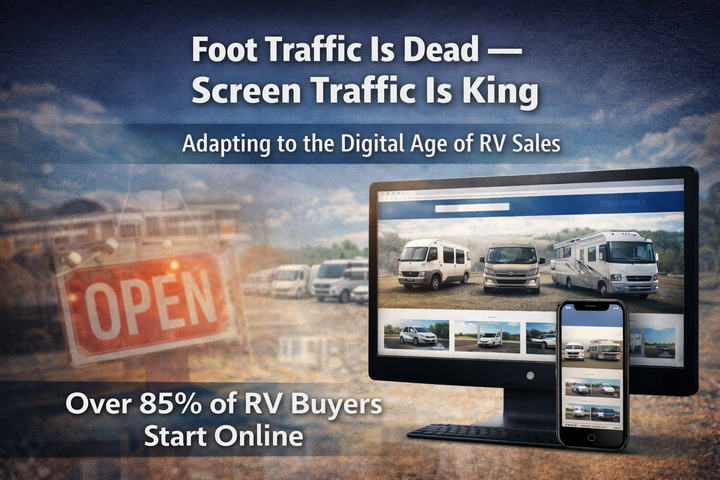
There was a time when the most important metric for an RV dealership was how many people walked onto the lot on a Saturday afternoon. Foot traffic was everything. Location mattered above all else. The dealer on the busiest highway with the biggest sign won.
Those days are over.
The buyer's journey has moved from the highway to the screen. From the lot to the phone. From the showroom to the search bar. And the dealers who haven't fully accepted that shift are slowly bleeding market share to the ones who have.
This isn't a prediction. This is what's already happening. The data is clear. The trends are undeniable. And the dealers who cling to the old model are running out of time to adjust.
The Numbers Don't Lie
The statistics around online shopping behavior aren't new but they're worth repeating because too many dealers still aren't acting on them.
The vast majority of RV buyers begin their search online. Not some. Not most. Nearly all of them. Before they ever visit a lot, before they ever talk to a salesperson, before they ever sit inside a unit — they've been on their phone or computer researching.
They're searching Google. They're browsing marketplaces. They're reading forums. They're watching YouTube walkthroughs. They're scrolling Instagram and TikTok looking at RV content. They're doing all of this from their couch at 10 PM on a Wednesday night.
By the time a buyer physically shows up at your dealership they've already narrowed their list. They already know what they want. They've already compared you to your competitors. In many cases they've already decided where they're going to buy — they're just coming in to confirm.
That means the sale isn't won on the lot. It's won on the screen. Long before that buyer ever shakes your hand the deal was already taking shape in the digital space. And if you weren't part of their online research phase you were never even a contender.
The Lot Still Matters — But Not Like It Used To
Let's be clear. This isn't about saying your physical lot doesn't matter. It does. The in-person experience still plays a role in closing deals. People want to see the unit. They want to touch it. They want to walk through it and imagine themselves living in it.
But the lot is no longer the starting point. It's the finishing point. The buyer doesn't discover you on the lot anymore. They discover you online and then come to the lot to finalize what they've already decided.
This fundamentally changes where you need to invest your time, energy, and money. If the lot is the closing stage then the digital space is the prospecting stage. And if you're not winning the prospecting stage you'll have nobody left to close.
Dealers who invest heavily in their lot experience but neglect their digital presence are building a beautiful store that nobody knows exists. It's like having the best inventory in town behind a locked door with no sign.
Where Are Your Buyers Right Now?
Right now as you're reading this potential buyers for your inventory are online. They're actively searching. They're on marketplaces looking at RVs. They're scrolling social media being inspired by travel content. They're typing questions into Google about which RV is right for their family.
The question is: are they finding you?
Are your listings showing up when they search for the type of inventory you carry? Is your dealership appearing in their social media feed? Are you present on the platforms they're using to shop?
If the answer is no then those buyers are finding someone else. They're finding your competitor who invested in their online presence. They're finding dealers in other states who made themselves easy to discover. They're finding private party sellers who posted in the right places.
Every buyer who searches and doesn't find you is a lost opportunity. And unlike the old days where your location gave you a geographic advantage, the internet has erased those boundaries. A buyer in your city can just as easily find and purchase from a dealer three states away if that dealer has a stronger online presence.
Screen traffic doesn't care about your location. It cares about your visibility.
The Old Marketing Playbook Is Failing
For decades RV dealers relied on a familiar marketing playbook. Billboard on the highway. Radio ads during drive time. Print ads in the local paper. Maybe a TV spot during the local news. Sponsor the county fair. Put up some flags on the lot.
And for a long time it worked. Because the buyer's journey was local and physical. They drove by your lot. They heard your ad on the way to work. They saw your name in the paper. Everything was built around being visible in the physical world.
But buyer attention has moved. It's on screens now. It's on phones, tablets, and laptops. The average person spends hours on their phone every single day. They scroll social media. They search Google. They browse online marketplaces.
How much time do they spend looking at billboards? Listening to radio ads? Reading the newspaper?
The old marketing playbook isn't just less effective. For many dealers it's become almost entirely ineffective. The dollars spent on those channels are producing a fraction of what they used to. And worst of all most of those channels are completely untrackable. You have no idea if that billboard generated a single lead. You can't measure whether that radio spot drove anyone to your lot.
Meanwhile every dollar you spend in the digital space can be tracked, measured, and optimized. You can see exactly how many people saw your listing. How many clicked. How many contacted you. What they searched for. Where they came from. What they looked at.
The shift from physical marketing to digital isn't just about following the trend. It's about spending smarter and knowing what your money is actually doing.
Social Media Is Your New Highway
If foot traffic came from being on a busy highway then screen traffic comes from being on social media. That's where the people are. That's where the attention is. That's where buyers are being influenced, educated, and inspired every single day.
Dealers who have built a strong social media presence are generating leads without spending a dime on ads. They're posting inventory walkthroughs. They're sharing customer testimonials. They're creating educational content about RV ownership. They're showing behind-the-scenes looks at their dealership.
And they're building trust with potential buyers long before those buyers are ready to purchase. So when the time comes to buy, that dealer is already the obvious choice because the buyer has been following them for months.
Social media is free to use. It costs nothing to post a 30-second walkthrough of a unit on your lot. It costs nothing to share a happy customer's story. It costs nothing to answer common RV questions on camera.
The dealers who are active on social media are building an audience. An audience of potential buyers who see their name, their inventory, and their brand every single day. That's a level of visibility that no billboard could ever match.
The Right Marketplace Matters More Than Ever
Social media builds awareness. Your website builds credibility. But the marketplace is where transactions happen. It's where buyers go when they're ready to shop. And being on the right marketplace in 2026 is one of the most important decisions a dealer can make.
Not all marketplaces are created equal. Legacy platforms that have dominated for years are resting on their name recognition while failing to innovate. They're charging premium fees while delivering a stale experience that doesn't match how today's buyers want to shop.
Modern platforms like TrueRVs are built differently. Built for screen traffic. Built for the way people actually search and shop in 2026. With AI-powered tools that match buyers with inventory. With advertising built into the platform that drives targeted traffic to your listings. With tracking features that show you exactly what's happening with every unit.
The marketplace you choose determines whether your inventory is visible or invisible to the buyers who are actively searching right now. Choose a platform that's growing, innovating, and actively working to put your units in front of the right people.
Winning the Screen Traffic Game
So how do you win in a world where screen traffic is king? Here's the playbook:
Be everywhere the buyer is looking. That means a strong website, active social media, optimized Google Business Profile, and listings on modern marketplaces that are actually driving traffic.
Invest in content. Photos, videos, walkthroughs, testimonials, educational posts. Content is the fuel that drives screen traffic. The more you create the more visible you become.
Leverage technology. Use platforms with AI-powered tools, targeted advertising, and robust tracking. Don't settle for a marketplace that just lists your inventory. Demand one that actively markets it.
Track everything. Every dollar you spend on digital marketing should be measurable. If you can't track it, question it. If you can track it and it's not working, change it.
Think like the buyer. Shop your own listings. Google your own dealership. Look at your social media through the eyes of a first-time visitor. Is what you see compelling enough to make someone choose you over the competition?
The Future Belongs to the Visible
Foot traffic isn't coming back. Not the way it was. The world has moved online and the RV industry is no exception. The dealers who accept this reality and aggressively build their digital presence will capture the lion's share of buyers in their market.
The dealers who keep waiting for people to drive by will keep waiting.
Screen traffic is king. Visibility is everything. And the platforms, strategies, and tools you invest in today will determine whether you're thriving or struggling tomorrow.
TrueRVs. Built for the screen traffic era. Get your inventory in front of the buyers who are already searching.
Make the shift at TrueRVs.com