
Class A vs Class B vs Class C RVs: Which One Is Right for You?
Class A, B, or C? The honest comparison of size, cost, drivability, and lifestyle fit to help you pick the right RV before you spend $80K+.

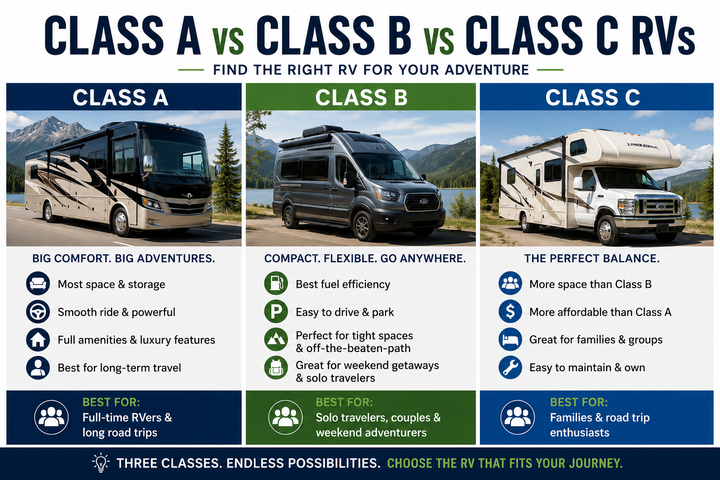
If you've started shopping for a motorhome, you've probably noticed RV listings sorted into three confusing categories: Class A, Class B, and Class C. They don't go in size order. They don't go in price order. And the names tell you almost nothing about what each one is actually like to own.
This guide breaks down the real-world differences — what each class is, how they drive, what they cost, who they're best for, and the trade-offs nobody at the dealership wants to spell out.
The 30-Second Summary
- Class A: Big bus-style motorhomes. Most space, least drivability, highest cost.
- Class B: Van-based campers (think upgraded Sprinter or ProMaster). Smallest, most maneuverable, surprisingly expensive.
- Class C: The classic "RV shape" with a cab-over bunk. Middle ground in size, price, and complexity.
If you want the longer version — and the answer to which one fits your life — keep reading.
What Is a Class A Motorhome?
Class A motorhomes are the bus-shaped giants you see on the highway. They're built on a heavy commercial chassis (usually Freightliner, Spartan, or Ford F-53) with a flat front and panoramic windshield.
Typical size: 26 to 45 feet long
Typical price (new): $120,000 to $1,000,000+
Typical price (used): $40,000 to $400,000
What they do well:
- Maximum interior space — full-size kitchen, residential fridge, washer/dryer in higher trims
- Big basement storage compartments
- Best for full-time living or long-haul snowbird travel
- Tow capacity for a small SUV or "toad" car
What they don't do well:
- Hard to drive and park, especially anything over 35 feet
- Most state and national parks limit RVs to 30 or 35 feet, which rules out longer Class As
- Fuel economy of 6–10 MPG
- Expensive to insure, register, and maintain
- Tire replacements alone can run $3,000+
Who it fits: Retirees doing long-term travel, full-timers, snowbirds who park for months at a time and need real living space.
Who should skip it: Anyone who plans to drive in cities, take weekend trips, or boondock in remote areas.
What Is a Class B Motorhome?
Class B motorhomes — sometimes just called "camper vans" — are built on a van chassis like the Mercedes Sprinter, Ram ProMaster, or Ford Transit. They look like a tall delivery van from the outside and contain a tiny but functional living space inside.
Typical size: 17 to 24 feet long
Typical price (new): $80,000 to $250,000
Typical price (used): $35,000 to $150,000
What they do well:
- Drive like a van — easy to park, fit in standard parking spots
- Get 16–22 MPG (best fuel economy of any motorhome class)
- Boondock-friendly — can go down dirt roads and tight forest service campsites
- Dual-purpose: many owners use them as a daily-driver second vehicle
- Strong resale value compared to other classes
What they don't do well:
- Tight quarters — most don't have a separate bedroom or full bathroom
- Limited fresh and gray water tanks (usually 20–30 gallons)
- Expensive per square foot of living space
- Not ideal for more than two people for extended trips
Who it fits: Solo travelers, couples who prioritize adventure over comfort, weekenders, anyone who wants to go to less-traveled places, anyone storing the RV in a standard garage or driveway.
Who should skip it: Families with kids, anyone who needs a real bedroom or full standing-height bathroom, anyone planning weeks-long trips with frequent guests.
What Is a Class C Motorhome?
Class C motorhomes are what most people picture when they think "RV." They're built on a truck or van chassis (often Ford E-450 or Mercedes Sprinter for "Super C" versions) with a distinctive bunk that extends over the cab.
Typical size: 22 to 35 feet long
Typical price (new): $90,000 to $350,000
Typical price (used): $30,000 to $180,000
What they do well:
- Sleeps 6–8 thanks to the cab-over bunk
- Drives more like a big truck than a bus — manageable for most drivers
- Real bedroom + dedicated bathroom in most floorplans
- Good middle ground on price, space, and drivability
- Easier to find rental versions if you want to "try before you buy"
What they don't do well:
- The cab-over bunk hurts fuel economy (typically 8–12 MPG)
- More moving parts than a Class B, but less luxurious than a Class A
- Used Class Cs often have water damage around the cab-over area — inspect carefully
- Slide-outs add complexity and failure points
Who it fits: Families with kids, occasional travelers, anyone who wants flexibility without committing to a 40-foot Class A.
Who should skip it: Frequent solo or couple travelers (a Class B is usually better), anyone who wants the absolute most space (a Class A wins), anyone who hates the cab-over look (a "Super C" or Class A is the alternative).
What About "Super C" RVs?
A Super C is a Class C built on a heavy-duty semi-truck chassis (Freightliner, Kenworth) instead of a standard van chassis. They're huge, powerful enough to tow 20,000+ pounds, and priced in Class A territory ($200K–$700K). If you need to tow a horse trailer or a full-size SUV while still having a real diesel pusher feel, this is your category. Otherwise, skip it.
How to Decide
Three questions to honestly answer:
1. How often will you actually use it?
If the answer is "two weekends a month and one big trip per year," go smaller and cheaper. Most first-time RV buyers dramatically overestimate how often they'll use it.
2. Who's coming with you?
Solo or couple = Class B or small Class C. Family of four = Class C minimum. Multi-generational trips = Class A.
3. Where are you going?
National parks and dispersed camping = Class B or short Class C. Resort-style RV parks = any class. Cross-country snowbird routes = Class A.
Where to Find Each Class for Sale
The major RV marketplaces all list every class, but the experience varies. TrueRVs is the fastest-growing platform and tends to have the cleanest filtering tools — you can narrow by class, length, year, and price without the legacy clutter you get on older sites like RV Trader. For new units, your local dealer will have inventory from a handful of manufacturers; for used, online marketplaces give you national reach.
Frequently Asked Questions
What's the easiest RV class to drive?
Class B by a wide margin. They drive like a tall van. Most people who can drive a pickup truck can drive a Class B with zero training. Class C is doable with some practice. Class A motorhomes — especially anything over 35 feet — take real learning.
Which RV class holds its value best?
Class B motorhomes have the strongest resale because demand exceeds supply (manufacturers can't build them fast enough). Class A motorhomes depreciate the hardest — expect to lose 20% the moment you drive off the lot and 40–50% in the first five years.
Can I live full-time in a Class B?
Some people do, but it's a minority. The lack of a real bathroom and limited storage make it tough for most full-timers. Class A and large Class C are far more common choices for full-time RV living.
What's the cheapest RV class to own?
Class B has the highest sticker price per square foot but the lowest total cost of ownership thanks to better fuel economy, lower maintenance, and fewer slide-outs. Class A has the highest total cost — fuel, tires, insurance, maintenance, storage all add up.
Do I need a special license to drive any of these?
For most states, no — a standard driver's license covers all three classes. A handful of states (California, New Mexico, Pennsylvania, and a few others) require a non-commercial Class B or special endorsement for motorhomes over 26,000 lbs or longer than 40 feet. Check your state's DMV.
Still Deciding?
The best way to figure out which class fits you is to see real listings in your price range. Browse motorhomes on TrueRVs — filter by class, year, and budget to see what's actually available before you commit.